


Answering with verifiable figures rather than with statements of intent is the function of Social Return on Investment (SROI): a methodology that translates into a ratio the social, economic and environmental value generated by an activity - for every euro invested, it quantifies the total value generated - social, economic and environmental - expressed in euros.
What SROI measures and what sets it apart from cost-benefit analysis
SROI is neither an internal performance indicator nor a sustainability report: it is a structured accountability tool, born at the intersection of social accounting and cost-benefit analysis, translating into financial proxies even those outcomes (or externalities) that pass through no market at all.
As for the differences, Economic Cost-Benefit Analysis (ECBA) answers this question: does the investment generate a net benefit for society as a whole? It is the instrument required by the European Commission for the appraisal of major projects co-financed by the Structural Funds, and it is designed to assess the economic sustainability of an intervention at the macro level.
SROI works on a different scale. It asks: whose life changes, and by how much? Its aim is not to justify a public investment before a Managing Authority, but to demonstrate - to social investors, to donors, to service commissioners - that an activity creates measurable and attributable value.
The difference is not hierarchical: the two instruments complement each other.
Where the two overlap
• Monetisation of non-market outcomes: both assign a financial value to benefits that carry no price - for instance volunteering hours, reduced hospital admissions, improved psychological wellbeing.
• Discounting: both discount future benefits to present value, recognising that a euro today is worth more than a euro five years from now.
• Counterfactual: both ask what would have happened in the absence of the intervention - deadweight in SROI, the baseline scenario in ECBA.
The operational differences
• Scale and audience: ECBA is a policy instrument, designed for appraisals at programme or public project level. SROI is a management tool, used also by small organisations and by social enterprises.
• Stakeholders as protagonists: in SROI, the direct involvement of stakeholders is not a procedural step, it is the methodological core. It is they who define which externalities count and how to measure them, keeping the analysis conservative and not maximising the ratio.
• Communication output: ECBA produces an ENPV (Economic Net Present Value) and a recommendation; SROI produces a ratio and a story of change, designed to be reported and narrated to different audiences.
Who uses SROI and why it matters to decision-makers
SROI is not a tool reserved for the non-profit sector. Its applications cover a far wider perimeter:
• Social enterprises and non-profit organisations: to demonstrate added value to funders, to guide internal allocation choices, to strengthen applications to calls for proposals.
• Public administration: to appraise service contracts, to compare bids at tender stage, to monitor the performance of concession holders according to value for money logic.
• Private companies: to measure and report the impact of their activities on stakeholders - employees, suppliers, local communities - within an ESG framework increasingly demanded by the market and by regulation.
• Event organisers, including sports events: a tournament or a large urban event activates value chains that traditional financial statements do not capture - local economic spillovers, sports participation, social cohesion, place branding. Those who co-finance these events increasingly ask for structured evidence, not merely attendance figures.
How SROI works: a six-stage process
The methodology unfolds in six stages which, in practice, overlap more than the numbering suggests.
Stage 1 - Establishing scope and identifying stakeholders. Before measuring anything, the boundaries must be defined: which activity is being analysed, over what period, for what purpose. And above all who the stakeholders are - not only the direct beneficiaries, but anyone affected by the activity, positively or negatively. An organisation delivering meals to elderly people at home has obvious stakeholders (the beneficiaries, the volunteers, the funding body), but also less visible ones, such as neighbours who stop providing informal support because the service does it in their place.
Stage 2 - Mapping outcomes. By involving the stakeholders, the so-called Impact Map is built: the theory of change linking inputs (resources deployed), outputs (activities delivered) and outcomes (changes produced). Mind the distinction: the output is "we trained 50 people"; the outcome is "30 of them found a job within six months".
Stage 3 - Evidencing outcomes and giving them a value. Each outcome is measured through specific indicators - objective, subjective, or both - and then monetised through financial proxies (approximations): for example the cost of a medical visit as a proxy for improved health, the cost of enrolling in a social activity as a proxy for reduced isolation. The choice of proxies is a highly delicate step: it must be documented and defensible.
What distinguishes an acceptable proxy from one that is not is its proximity to the value perceived by the stakeholder: the best proxy is the one that comes closest to what the stakeholder would themselves assign to that change. Hence the importance of the hierarchy of sources: institutional data and replicable peer-reviewed studies first; internal estimates only as a last resort - and these, if not verifiable, weaken the entire calculation.
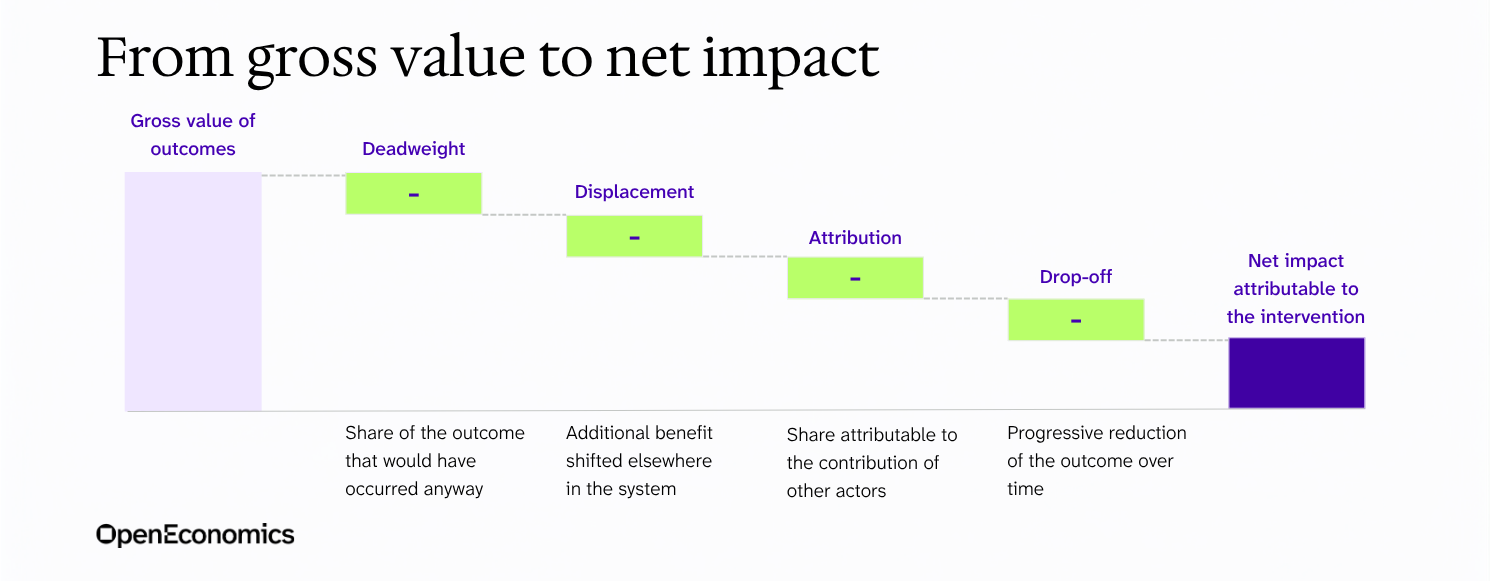
Stage 4 - Establishing impact. Not all change is attributable to the intervention. SROI introduces a number of corrections: deadweight (the share of outcome that would have occurred anyway); displacement (the share of benefit that is not additional, because it has simply been shifted elsewhere in the system: for example a job created that has pushed out an existing one); attribution (the share due to the contribution of other actors); drop-off (the progressive decline of the outcome over time). Applying them well is what makes the number credible.
Stage 5 - Calculating the SROI ratio. The present value of all outcomes is summed, negative values are subtracted, and the total is divided by total inputs. "Present value" is not an accounting detail: benefits materialising in later years must be discounted by applying a social discount rate - typically between 3.5% and 5% in international standards - because a euro of social value generated five years from now weighs less than one generated today. The result is a ratio: an SROI of 3:1 means that every euro invested has generated three euros of social value. The ratio must always be accompanied by a sensitivity analysis - verifying how much it would change were the most uncertain estimates different.
Stage 6 - Reporting, using and embedding. The result of the analysis is typically used in institutional relations, to communicate an achievement to stakeholders, to improve activities, and is often embedded in the monitoring systems of organisations.
Forecast or evaluative SROI: which to choose and when
The analysis can be carried out ex ante - to estimate the social value an activity could generate, in support of a business plan or of an application to a call for proposals - or ex post, on the basis of outcomes actually achieved.
Forecast SROI is useful at the design stage: it helps to understand which outcomes to oversee, which data collection systems to activate, where to concentrate resources in order to maximise impact. It has the advantage of requiring less time and less data. The limitation? It is based on estimates. These estimates, however, are not arbitrary: they rest on data from the scientific literature, on comparable analyses already carried out on similar interventions, or on direct consultation with stakeholders, transparently documenting the assumptions and their associated ranges of uncertainty.
Evaluative SROI requires solid data on actual outcomes, and is for this reason more costly to produce - but it is also the most credible for an external audience, including institutional donors and public authorities.
For many organisations, in our long experience, the natural path is to start with a forecast, use it to structure a monitoring system, and reach evaluation in the following cycle.



.png)








.png)