


Starting to explore AI was exciting; the hard part was turning company-wide experimentation into better processes and products.
Over the past few months at OpenEconomics, artificial intelligence has gone from an experimental tool to a piece of working infrastructure. It did not happen in a day, and it did not happen on its own. Faced with the choice between ignoring it and adopting it everywhere, we took a third route: treating it the way we treat any analytical methodology. Test first, adopt afterwards. It took three phases, not always linear ones, to get where we are.
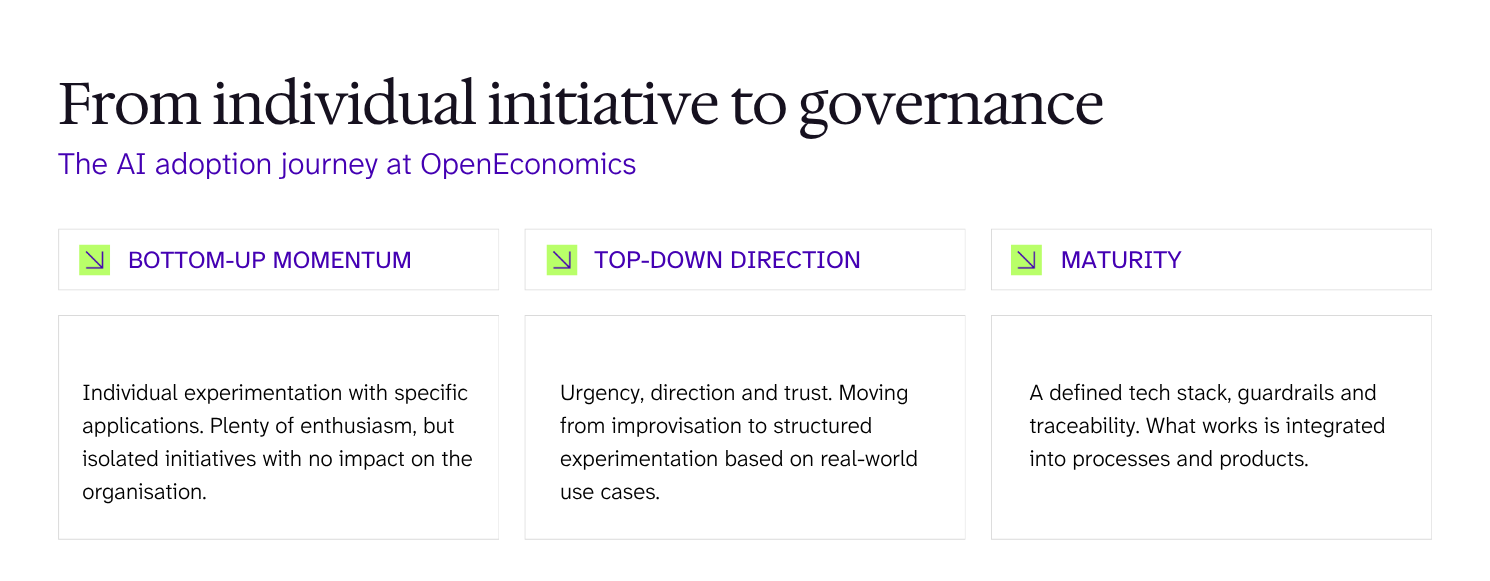
Bottom-up momentum, isolated initiatives
Artificial intelligence adoption began, as often happens when new technologies arrive, as a personal initiative. The more curious among us tried the tools out on their own work, often alone, on very specific applications: from generative AI tools for data science to generative tools for video tutorials, to give two real examples.
This was the momentum phase: enthusiasm for something new, the tangible sense that certain things could be done faster (and single-handedly, a point we will come back to).
But they were islands. Everyone worked on their own, with no real impact on the organisation as a whole. Now and then we fell in love with tools that, when put to the test, turned out to be unsuitable. There was also a subtler limitation: the focus remained entirely internal, concentrated only on what each of us could do more quickly, rather than on the processes that involve everyone or on innovation for our clients.
Top-down direction, the turning point
At a certain point, individual initiative (and the entropy that came with it) was no longer enough. The scale of the technological shift was such – as the board itself recognised – that the risks and the opportunities could no longer be ignored. So a clear signal came from the very top, summed up in this paradigm: urgency, direction, trust.
Urgency: not a generic invitation to experiment, but strong pressure to learn to work in a new way, on the same scale (indeed, a larger and faster one) as when the personal computer arrived in offices in the 1980s: those who learned to use it early worked better, those who waited found themselves behind.
Direction: AI was to involve the whole company, not only those already convinced, and to enter processes and products pervasively (individual > team > company). Once a safe perimeter had been defined, we moved from improvisation to structured experimentation. In practice, we built specific use cases, tested them on real work, mapped their limits and defined validation criteria. Whatever proved to work went into our processes (for example, a new process for bidding on public tenders) or into our products (the automatic checklists in our reporting products). The rest stayed out, or is still in testing.
A crucial ingredient was trust: giving people the space and the time to stop for a moment and redesign the way we worked, instead of asking them to add new tools on top of old processes. Every team had the chance to try doing things differently.
It was not painless. Changing the way you work while you carry on working, learning something new every week, is hard going.
But for the first time the entire company started playing on the same field: a necessary precondition for AI to become a democratic infrastructure inside OpenEconomics, with the same starting point for everyone, even if it is then used in different ways and to different degrees.
Maturity means setting yourself some rules
Today, as often happens in the hype cycles of innovative technology adoption, we are in a third, more mature phase: less improvisation and more structured governance.
We have settled on a main stack, built around Claude and a small set of function-specific tools.
Together with the security team we defined clear guardrails on what an AI system can and cannot touch: the processes remain ours, with our rules; AI carries out tasks within those processes, it does not replace them.
Access is another crucial point: it runs through a centralised gateway that guarantees consistency of configuration, cost control and traceability of use. Oversight rests with a two-tier AI Committee - strategic and operational - which validates technology choices and safeguards alignment with internal policies and applicable regulatory constraints. We wanted every point of access to AI to be tracked and governed from the outset. Not for the sake of bureaucracy, but because in a company that works on compliance and regulation, consistency between the approach we take externally and what we do internally is not negotiable.
Human oversight remains a fixed point, with no exceptions. In the principle of human control over every output we do not see a step back from technology, but rather a way of valuing the expertise of the professionals who check the result. AI speeds up the work, but the judgement on what is correct, useful and ready for a client stays with people.
Then came the idea of a Knowledge Intelligence designed specifically for us: a mine of information and data, shared skills and processes that anyone can query, putting AI to work within a safe perimeter and in a way that is relevant. We then realised that the model worked, and that it could become the way we design solutions for our clients. Sonar is the first concrete example.
The focus of many professionals has shifted, from “producing” a piece of writing, a portion of software or a video to “certifying” the quality and the standards of a result. In software development, for instance, vibe coding has made it possible to speed up the mere writing of code, while software engineers concentrate and express their value in architecture and in the review and standards-control phase. In every area we execute less, but we take responsibility for the quality of the product we deliver, including when it is built with the help of AI.
What we take away from our artificial intelligence adoption journey
What we got wrong. At the start we treated AI as one team’s task, rather than as everyone’s responsibility and everyone’s opportunity. It took us time to understand that no isolated group, however competent, can make an entire organisation’s way of working evolve.
What we think we got right. We understood early on that context counts as much as the tool: we were not interested in generic AI, but in AI applied to our specific processes, and not only to our data, which is always handled responsibly in line with the regulations in force. That is the difference between using a tool occasionally and genuinely integrating it into a new way of working. And it is a principle that matters even more today: with so many different and often interchangeable models on the market, the competitive advantage does not lie in the model you choose, but in how you integrate it - the rules you give it, the processes you place it in, the controls you build around it.
What we are still learning today. The easiest metrics to measure are the efficiency ones: a prototype ready to show a client in three days instead of two months. But what is the value for the client, beyond the speed? That is the next step: customer-oriented KPIs, which also speak of value and perceived value, not only of greater speed.
The technological leap has been considerable. The organisational one even more so, and it is still being consolidated, because it requires revisiting all the processes that are specific to our company, and our own personal way of working. Over the coming weeks we will tell the story of the stages of this journey on LinkedIn, mistakes included. If the topic is close to home for you, follow us.



.png)








.png)