


With the Economic Appraisal Vademecum (EAV), since 2021 the European Commission has published a technical tool that complements the CBA - which remains the recommended approach - with two further appraisal approaches – broken down into three tools - to be used in specific circumstances linked to the sector, type and scale of the project.
Simplifying from the outset
Until 2020, applying for EU funding with a project worth 2 or 3 million euro often meant producing a cost-benefit analysis designed for large infrastructure (motorways, railways, hospitals, etc.).
This approach entailed determining shadow prices, social discount rates, the monetisation of environmental externalities and so on; a complex exercise that required a great deal of time and specialist expertise. The result was, often, that many municipalities gave up, especially the less well-equipped ones.
With the Economic Appraisal Vademecum (EAV), in 2021 the European Commission published a technical tool that complements the CBA - which remains the recommended approach - with two further appraisal orientations, to be used in specific circumstances linked to the sector, type and scale of the project.
Three examples of simplified cost-benefit appraisal
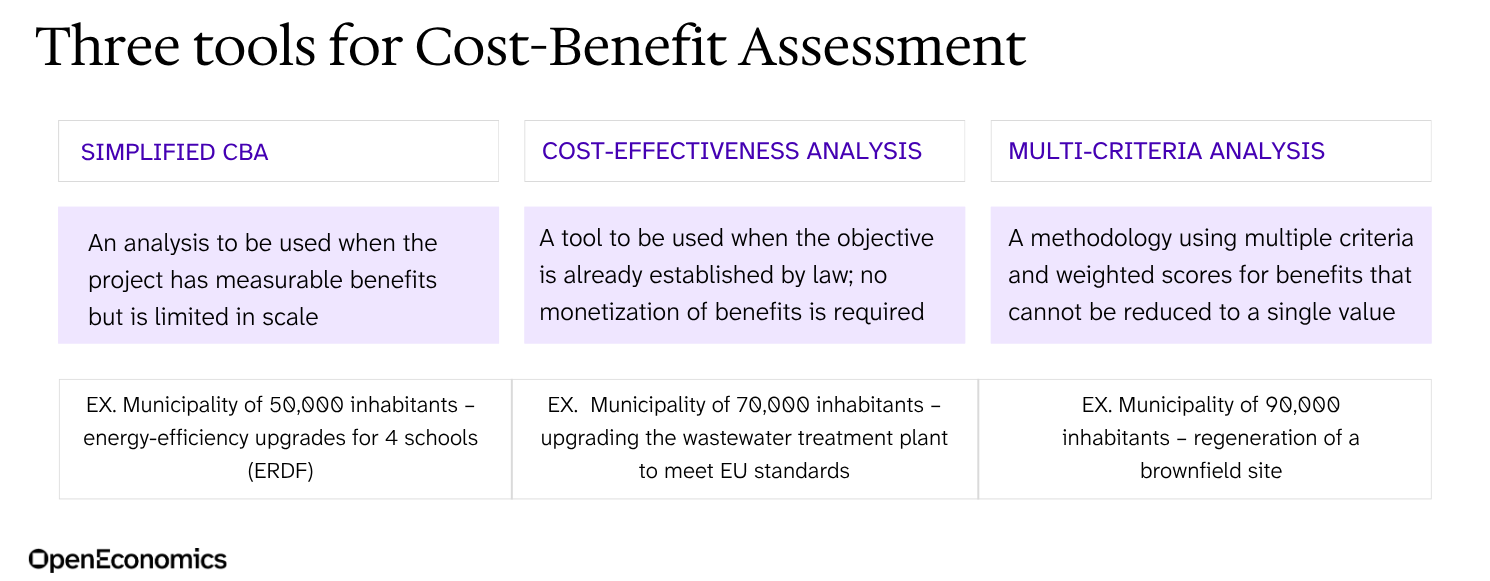
Simplified CBA: when the project has measurable benefits but a limited scale
A municipality of 50,000 inhabitants applies for a 3 million euro project for the energy efficiency upgrade of four schools under the European Regional Development Fund (ERDF). Under the previous regulatory framework, the municipality would have had to estimate the economic value of the CO₂ saved over 25 years using certified shadow prices. With the simplified CBA, instead, it can use market energy tariffs, calculate the annual savings on bills and describe the environmental benefit using data from the Regional Agency for Environmental Protection (ARPA). The same rigour in decision-making, but less work.
Cost Effectiveness Analysis (CEA): when the objective has already been set by law
A municipality of 70,000 inhabitants has to bring its wastewater treatment plant into line with the standards of Directive 91/271/EEC concerning urban waste water treatment. It is not a choice but an obligation, and the works therefore have to be carried out. The Cost Effectiveness Analysis (the analysis of the best cost/result ratio) compares the available technical solutions and identifies the one with the lowest cost per population equivalent served. No monetisation of environmental benefits: it is not needed, because the objective has already been set by the legislation.
Multi Criteria Analysis (MCA): multiple criteria and objectives that cannot be reduced to a single number
A municipality of 90,000 inhabitants wants to regenerate a disused area: a cultural centre, an area of public green space, a new cycle path. The benefits are real but heterogeneous – social cohesion, urban quality, accessibility – and cannot be added up into a single economic value. The Multi Criteria Analysis (appraisal against several criteria and objectives) assigns weighted scores to the project options across multiple dimensions. The result is a transparent ranking of the alternatives, one that can be defended before the managing authority and before citizens.
The link with simplified reporting
The regulatory framework enriched by simplified Cost Benefit Analyses and by simplified reporting are two sides of the same logic. Simplified CBAs make the ex ante appraisal of the project easier; simplified cost options (SCOs) and financing not linked to costs (FNLC) simplify final reporting, replacing itemised invoices with parameters and standard costs defined upstream. In both cases, complexity shifts from the operational phase to the initial methodological design. Those who build that phase well gain legal certainty in all the phases that follow.
What to do right away
• Check which appraisal tool is indicated in your Regional Operational Programme 2021–2027: not all of them have taken up the EAV, and applying the old CBA out of habit can cost you unnecessary time and resources.
• Download the spreadsheet model template published by DG REGIO as a complement to the EAV, and then structure your project's cash flows in a way that is compatible with the managing authorities' control systems.
• Ask your regional ERDF or NRRP contact person whether there is a national methodological framework updated to 2021–2027, or whether you are still working with the rules of the previous cycle.
The simplification promised by the EAV is not automatic: it works only if ex ante appraisal, management and reporting speak the same language from the very start of the project. It is this methodological work that makes the difference, and that we are carrying forward together with public administrations, combining scenario analysis, the design of simplified instruments and support for their concrete application.



.png)








.png)