


Imagine commissioning the energy renovation of a school and paying the contractor not based on the work done or the materials used, but only when the gas bill shows at least 30% less than the previous year. This is the logic of FNLC (financing not linked to costs): the public contribution does not reimburse what you spent but recognizes the result you achieved.
Until now, this criterion was more of an aspiration than a widespread practice. A recent study commissioned by DG REGIO of the European Commission suggests, however, that we are closer than we think. The research was conducted by t33 — now part of the OpenEconomics group — together with CSIL and Spatial Foresight, and published in September 2025.
What are FNLC in brief?
FNLC (financing not linked to costs) are a form of European Union contribution in which payments do not reimburse costs incurred but depend on the achievement of pre-established conditions or results. Amounts and conditions (targets and milestones) are set ex ante and verified solely on the basis of performance, without verification of individual invoices for actual costs.
43 indicators ready for FNLC
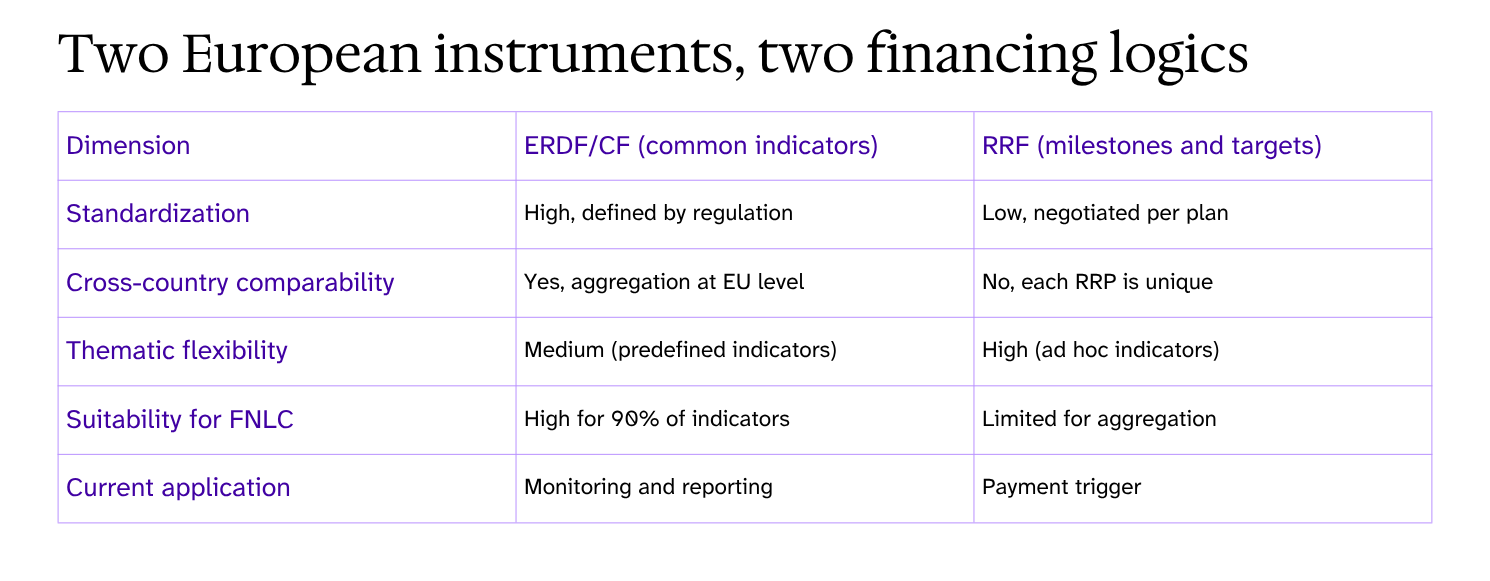
The study analyzed 204 ERDF and Cohesion Fund 2021–2027 programmes, assessing all common indicators used by Member States to measure outputs and results. From the cross-referencing of frequency, relevance and consistency, a subset of 43 common indicators emerges — both output and result indicators — sufficiently robust, homogeneous and well-documented to be used as payment conditions in an FNLC system. The ERDF/CF system already has a solid methodological foundation: standardized indicators, defined by regulation and applicable uniformly across all Member States. This is precisely what the RRF (Recovery and Resilience Facility) lacks, whose system of milestones and targets is negotiated on a country-by-country basis and does not allow aggregation at European level. It is no coincidence that the European Court of Auditors has raised concerns about the limited comparability of RRF monitoring. The study commissioned by DG REGIO shows that 90% of the ERDF/CF indicators examined already addresses those concerns, offering guarantees of robustness and verifiability that the RRF system does not provide. In terms of coverage, the number of indicators used per programme ranges from 13 (Luxembourg) to 325 (Slovakia), while Italy sits in the medium-high range with 94 indicators per programme.
How it works in practice: two examples
The study goes beyond theory. For each type of intervention, it builds an operational map called the Investment Action Matrix, which indicates which indicator to use at each phase: when the project is launched, when the intervention is completed, and when the result is measurable. Payment is triggered only at the last stage.
Two concrete examples:
· Energy efficiency in public buildings (32 billion euros allocated at European level under the specific objective on energy efficiency in the 2021–2027 cycle): the process starts from project approval, the number of renovated buildings is counted, and the actual reduction in energy consumption is measured. Payment is triggered only when the meter reads lower. The critical point is timing: how long do you wait before measuring the savings? This rule must be written before the intervention, not after.
· Support for SMEs and job creation (37 billion euros allocated at European level under the specific objective for SME growth and competitiveness in the 2021–2027 cycle): the output is the number of firms financed, the result is the jobs created and innovations introduced. The difficulty is that "firms financed" is a very generic indicator: financing a craft micro-enterprise or a technology start-up are radically different things, yet both end up in the same counter. Setting a stable and fair payment value becomes complicated.
What is still missing
If the tools exist, why are Cohesion indicators not yet being used for FNLC? The study identifies three concrete obstacles.
The first is excessive heterogeneity: the same indicator covers very different interventions, making it almost impossible to set a fair and comparable payment value. The second is the complexity of measuring results: tracking medium-term effects requires post-intervention data collection systems and independent verifications that many Managing Authorities do not yet have. The third is a scale problem: some indicators measure aggregates — such as "enterprises supported" — that cannot be broken down to the level of individual beneficiaries, making it difficult to apply FNLC logic all the way down the chain.
The solution put forward by the study is to always combine the three levels — process, output, result — to distribute risk among all actors involved, rather than placing it on a single one.
What can be done in the 2021–2027 programming period?
Italy has a solid foundation, but needs to take three concrete steps: first, to use the large volume of data already produced by the National Recovery and Resilience Plan (NRRP) and Cohesion Policy on schools and hospitals as a starting point for FNLC schemes on energy efficiency; second, even at this final stage of the 2021–2027 programming period, to test and pilot the use of FNLC — Managing Authorities could use common indicators as targets and milestones in regional or national programmes, also to accelerate expenditure; third, to invest in administrative capacity and data governance, because the challenge is not having the indicators, but collecting, verifying and linking them to payments in a timely manner.
Research from the inside
This study grew out of the experience accumulated by t33, now part of the OpenEconomics group, over years of evaluation and monitoring of European cohesion policies. It is not an analysis conducted from outside the system: it is the result of daily work in direct contact with programmes, data and Managing Authorities across Europe.




.png)








.png)