


Securing funding is the result of months of work. But it also marks the beginning of the most delicate phase — the one that most implementing bodies face without being fully equipped to do so.
In the lifecycle of public funding, there is a moment that tends to be misunderstood. It is when the official communication arrives: the project has been funded. The competitive phase is over. The objective appears to have been achieved.
In reality, this is precisely where the most critical phase begins.
The moment the decree is issued is not — as is often perceived — the moment when the hard work ends. It is the moment when it changes shape. This also applies to the first implementation tranche of the National Plan for Infrastructure Interventions and Water Sector Security (PNIISSI), which has already allocated over €950 million to 75 implementing bodies, now facing new operational challenges, while awaiting a second tranche expected in the summer.
Why reporting on PNIISSI funding is strategic
Those who have already managed other programmes — PNRR, structural funds, regional funding — know that each instrument follows its own logic. PNIISSI is no exception. On the contrary.
It is not just about delivering a project, but about:
• complying with a structured system of constraints — sector-specific rules governing the water sector;
• managing a reporting cycle based on stages of work progress (SALs);
• ensuring compliance with precise requirements for expenditure traceability and mandatory consistency across technical, administrative and financial documentation.
Within this framework, funding is never “liquid”. It is not a lump sum that is disbursed and freely used. It is a constrained, carefully phased flow, activated only when specific conditions are met and evidenced according to defined deadlines.
The blind spot: what happens after allocation
Most organisations concentrate their energy and attention on the application phase. This is understandable: it is the competitive stage, where access to funding is decided.
The subsequent phase — implementation and reporting — is less visible. Yet this is where risks emerge. Errors that rarely surface immediately, that accumulate over time and that, in the worst cases, only become apparent when it is too late to correct them without consequences.
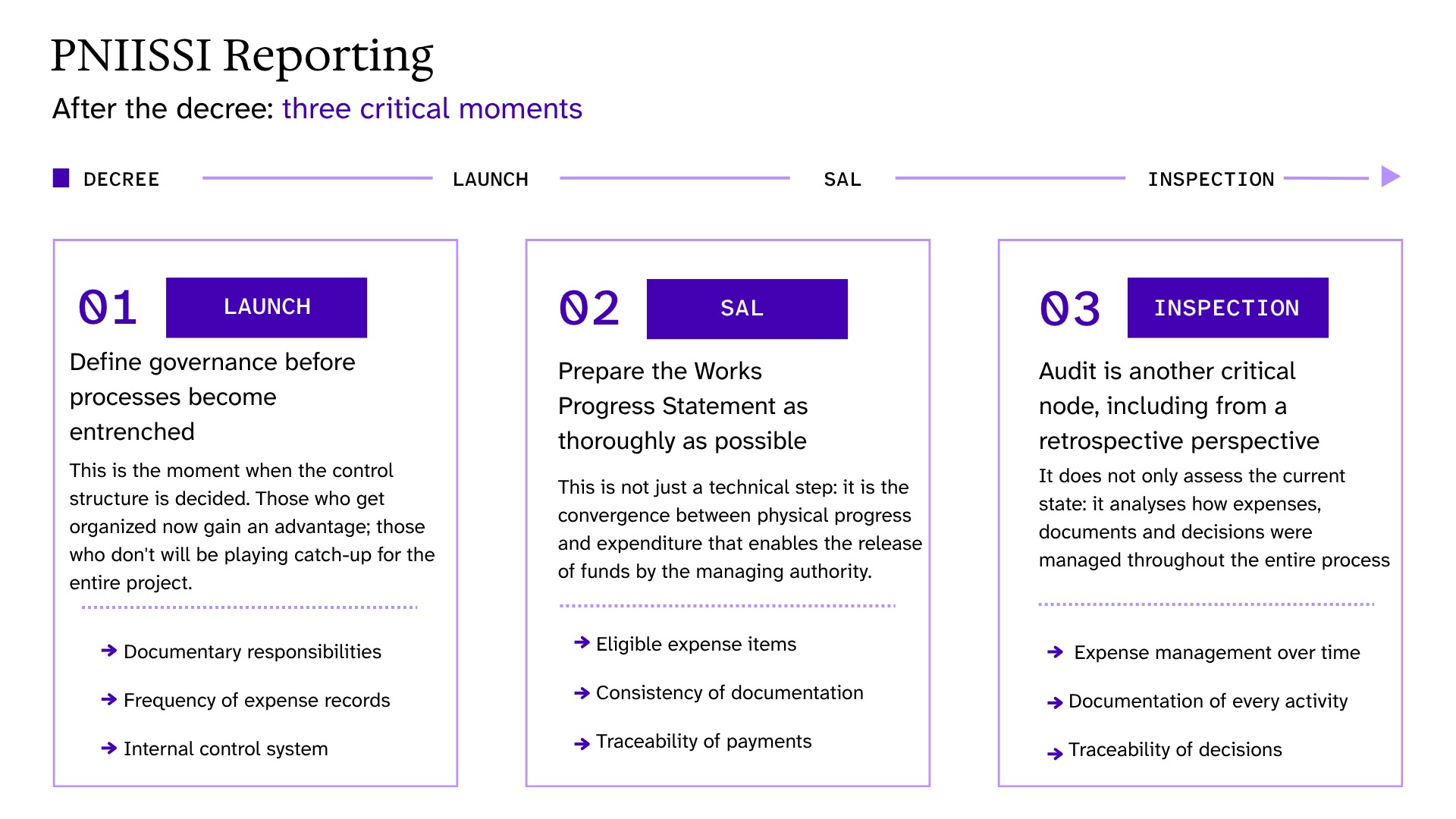
There are three critical moments.
The first critical point: the start-up phase of a PNIISSI-funded project
This is when project governance is defined — or not. Who is responsible for documentation? How frequently are expenditure records updated? Is there an internal control system in place before the external one intervenes? Organisations that structure themselves properly at this stage have far greater room for manoeuvre in the months that follow. The others end up playing catch-up.
The second: preparation of the SAL
A statement of work progress is not merely a technical step: it represents the alignment between the physical progress of the project and the progress of expenditure that enables the managing authority to disburse funds. Errors at this stage — ineligible items, inconsistencies in documentation, lack of traceability of payments — can block the disbursement of the corresponding instalments. In projects worth tens of millions, even a partial suspension can have significant impacts on the liquidity of the implementing body and on the project’s cash flow.
The third slippery area: inspection
This is when the window for making corrections has closed. One can only respond with what is already in place. The audit does not assess only the current situation: it is a retrospective analysis of the entire process — how expenditure has been managed, how each activity has been documented, how decisions have been taken. If the system has not been properly set up from the outset, the audit does not reveal a single error. It reveals a pattern. And at that point, the ability to intervene is almost nil.
What happens when a SAL is blocked?
This is the point — or rather, the tipping point.
If a SAL is blocked or challenged, the flow of payments is interrupted. The project enters a verification phase. Requests for additional documentation multiply. Timelines lengthen, operational costs increase. In the most serious cases, this can lead to the ineligibility of expenditure or the non-recognition of the contribution, up to the potential activation of administrative procedures which, in more critical situations, may result in the partial or total revocation of the grant, with an obligation to repay any amounts already received, plus interest.
There is also a reputational cost that goes beyond the project itself: non-compliance is recorded in the databases of funding authorities and, in cases of more significant breaches, may be reported in monitoring systems and lead to exclusion from access to future funding.
Here is the final part translated into British English, consistent in tone and terminology:
The real window lies in PNIISSI reporting, before, not after
The key factor is timing. We have observed this across many projects. Most corrective actions take place once the issue has already emerged — when a request for clarification arrives, when a document does not align, when a control highlights a critical issue. At that point, the room for manoeuvre is already limited.
The true window for intervention, even within PNIISSI, is earlier: before works begin, before the first SALs are produced, before processes become embedded in the wrong way. It is at this stage that document flows can be structured, clear governance defined, the technical dimension aligned with the administrative one, and the most likely risks anticipated for each specific intervention.
Risk changes shape, it does not disappear
In PNIISSI too, the moment funding is awarded is when risk changes form: from competitive risk — whether or not funding is secured — to operational risk, namely the ability to manage it effectively over time.
Organisations that perform best are not necessarily those that win the most projects. They are those that treat reporting as an integral part of the project, not as an ancillary activity, anticipating errors rather than correcting them.
If your project has already been funded under the first tranche, the question is no longer “have we secured the funding?”. The real question is: are we structured to manage it without errors?
If, on the other hand, you have projects currently on the waiting list and not yet funded, prepare them and keep them ready for updates: a new resource boost has been made available, SFNIISSI — an innovative financial facility announced by the Government — which will prioritise projects already submitted under PNIISSI but not yet funded.




.png)







.png)