


Have you ever heard of a municipality that won a European grant, approved the project, signed the agreements — and then failed to spend the money on time? This is not an isolated case. It is a systemic, well-documented phenomenon with a precise name: lack of administrative capacity. Funds are not the problem. Ideas are not the problem. What is missing is trained staff, functioning processes, and systems to collect data and demonstrate that money has been spent effectively.
For the 2021-27 programming period, the European Commission decided to change course — and did so concretely, by introducing a new instrument: ACB Roadmaps (Administrative Capacity Building Roadmaps), which establish that every Partnership Agreement must identify administrative capacity shortcomings and plan actions to address them.
Capacity building: an old problem, a new response
In previous programming cycles, strengthening the capacity of public administrations was considered optional. Technical assistance existed — a share of funds earmarked for internal organisation — but its use was left to the discretion of each Member State. The result? Sporadic interventions, compliance-focused training courses that changed nothing in day-to-day working practices, and the same problems resurfacing at the end of each period. With the CPR (Common Provisions Regulation) 2021 — the legislative text establishing the rules applicable to all major EU funds in the 2021-2027 cycle — the logic shifts fundamentally. Every Partnership Agreement and every programme must explicitly identify administrative capacity shortcomings and plan actions to address them. This is no longer optional: it is a governance requirement. The European Commission, in collaboration with the OECD, has made available a set of practical tools to support the development of ACB Roadmaps — strategic documents that map real needs, define measurable objectives, and plan concrete actions in the short, medium and long term.
ACB Roadmaps: what do they focus on?
To date, fifteen Member States have developed an ACB Roadmap — a significant number, though not all. A reading of the roadmaps adopted so far reveals four recurring problems across almost all of them:
• Insufficient staffing: inadequate headcounts, high staff turnover, and knowledge lost whenever officials move to a different office.
• Beneficiaries are not ready: opening a call for proposals is not enough — those expected to apply often lack the skills to design projects, report expenditure, and comply with rules.
• Procedures are too complex: internal bureaucracy is as burdensome as external red tape, and streamlining it requires a systematic effort that is rarely undertaken.
• IT systems do not hold up: outdated digital tools, disconnected databases, and data flows that break down halfway through.
The training course trap
There is a fundamental misconception in how many public administrations approach this issue: the belief that capacity building means organizing training courses. This is a dangerous oversimplification. A trained official who returns to an office with dysfunctional processes, inadequate software, and no managerial support cannot put into practice anything they have learned.
Both the literature and practice point to four dimensions that must be addressed together: people (skills and availability), the organization (processes, tools, and internal culture), and the institutional context (rules and procedures within which the organization operates). Addressing only one while leaving the others unchanged is like replacing an engine on a car with flat tyres.
What the latest study on capacity building shows
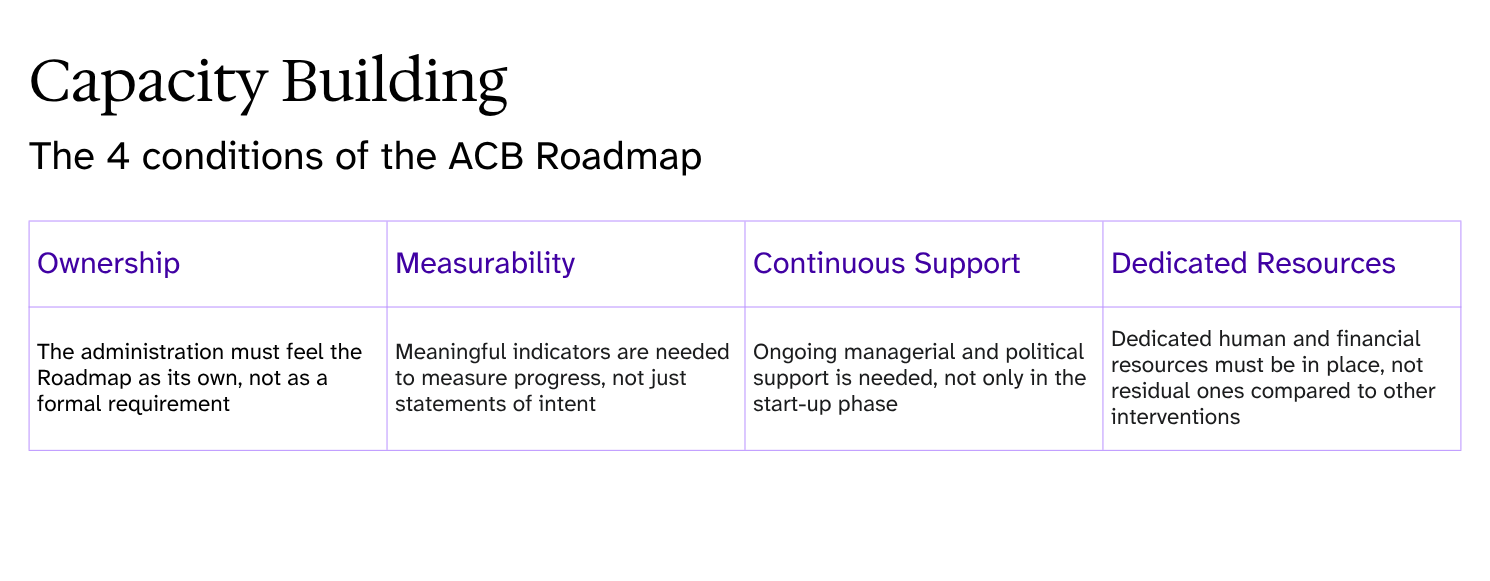
A study conducted by t33 for DG REGIO (the European Commission's Directorate-General for Regional and Urban Policy) — published in February 2026 — analyzed how ACB Roadmaps have been designed and implemented in the 15 Member States that have adopted them. The verdict is clear: the instrument works, but only when four specific conditions are met:
• First, the administration must take genuine ownership of the process, rather than treating it as a formal compliance exercise imposed from above.
• Second, meaningful indicators to measure progress are needed, not just statements of intent.
• Third, sustained support from management and political leadership is required, not only at the launch phase.
• Fourth, dedicated human and financial resources must be allocated, not treated as residual to other interventions.
When any one of these conditions is absent, the roadmap remains on paper. The Commission commented on the study with a direct message: administrative capacity building "must be maintained and strengthened" in future programming cycles.
What Italy can do
In Italy, all regional ERDF programmes and five national programmes have developed their own Roadmaps, known as PRigA (Programmi di Rigenerazione Amministrativa — Administrative Regeneration Programmes), building on the PRA framework already used in 2014-2020. A further concrete step has been taken: the national programme CapCoe (Capacità per la Coesione — Capacity for Cohesion) is entirely dedicated to strengthening the capacity of administrations in less developed regions to manage cohesion funds. This signals awareness, but the real challenge is not launching the programme — it is building a system in which competencies are retained, transferred, and deliver measurable results cycle after cycle, in a logic of continuous improvement.
A perspective from the field
T33 — now part of the OpenEconomics group — has worked on capacity building for Managing Authorities for years, both in Italy and across Europe: from needs assessment to the design of training systems, from building effectiveness indicators to evaluating interventions. The work on this study for DG REGIO is the product of an observatory built over time, in direct contact with those who manage programmes day after day.




.png)








.png)