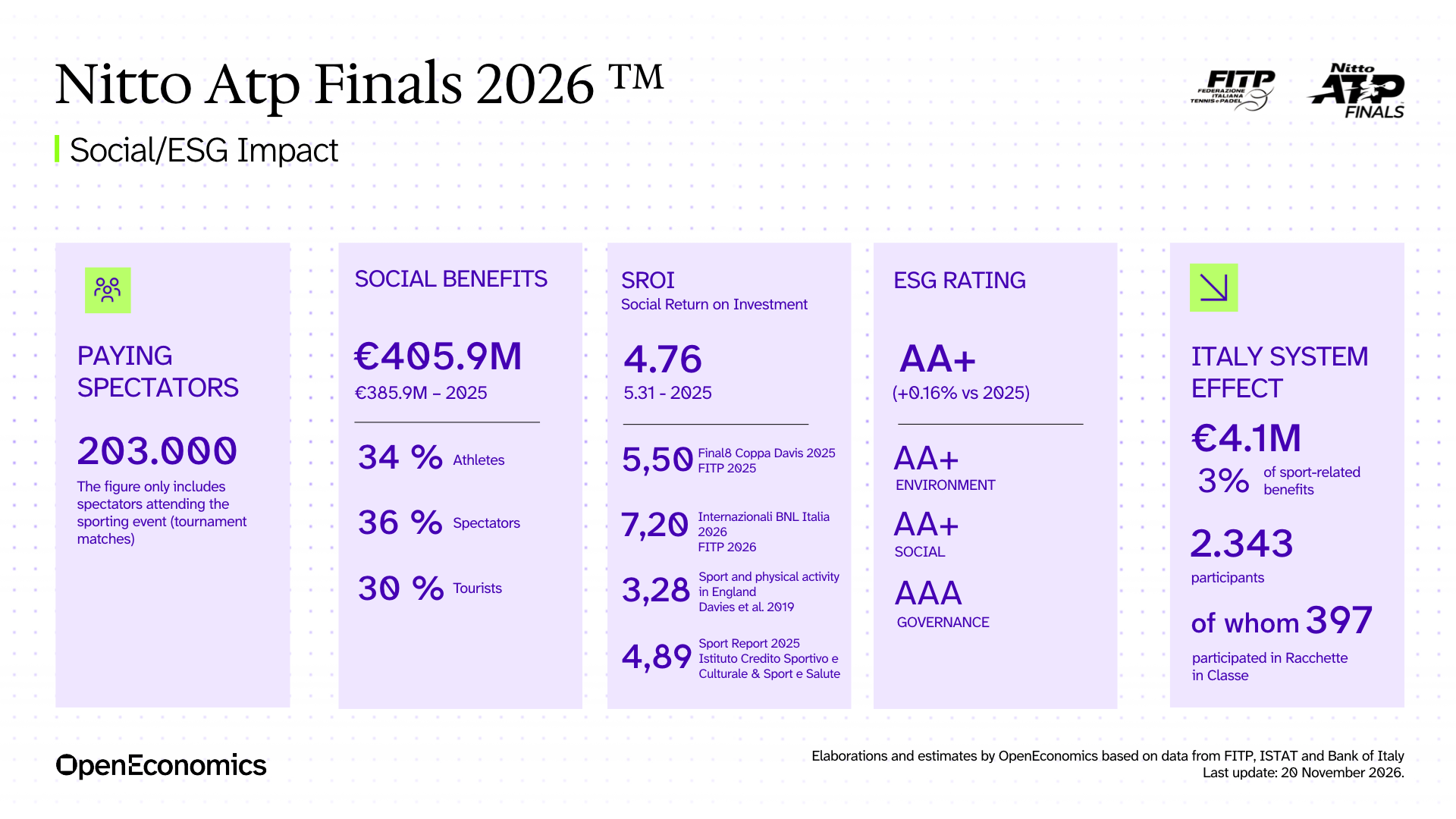
The Nitto ATP Finals 2026, which ended yesterday in Turin, return €4.76 in social benefits to the community for every euro invested. This is the main finding of the social impact analysis carried out by OpenEconomics for FITP (Italian Tennis and Padel Federation). Social benefits are estimated at €405.9 million, up from €385.9 million in 2025, while the SROI falls from 5.31 to 4.76. The ESG rating is AA+.
Objectives of the study
FITP presented the results of the 2026 edition, played without Jannik Sinner, who was out injured, an absence that federation president Angelo Binaghi described as a “stress test” passed. Meanwhile, local institutions have set the goal of keeping the Finals in Turin until 2030.
Within this framework, OpenEconomics’ analysis answers a specific question: how much value the event returns to the community in the form of social benefits, relative to the investment, and with which environmental, social and governance practices it is organised. It does not estimate the spending generated or the value added produced, which belong to economic impact analyses.
Key findings: Nitto ATP Finals 2026 social impact
The social impact of the Nitto ATP Finals 2026 amounts to €405.9 million in estimated benefits. The SROI (Social Return on Investment) relates these benefits to the investment: a value of 4.76 means €4.76 in benefits for every euro invested. Compared with 2025, benefits rise from €385.9 million to €405.9 million, while the SROI falls from 5.31 to 4.76. If the ratio falls while benefits grow, the costs included in the calculation have increased in proportion to the value produced. For this edition, FITP increased its investment by €5.5 million compared with 2025 for staging and facilities, plus a further €7.7 million for marketing and promotion.
Spectators, sports participants and tourists: who generates the value
The social impact of the Nitto ATP Finals is split into three similar shares: 36% of benefits is attributed to spectators, 34% to sports participants and 30% to tourists. No component clearly prevails, so the result does not depend on a single category of beneficiaries. The spectator share refers to an audience that the infographic puts at 203,000 paying spectators, counting tournament matches only.
The analysis also estimates 2,343 persistent sports participants, 397 of whom are linked to Racchette in classe (“Rackets in the classroom”), the free national project promoted by FITP to introduce Italian school students to racket sports. This indicator links the event to youth sports participation and should be read as an estimate, not as a causal effect.
ESG rating: AA+ overall, AAA for governance
Alongside the monetised benefits, the analysis assesses how the event is organised through an ESG (Environmental, Social and Governance) rating, a summary assessment of environmental, social and governance performance. The overall rating is AA+, with AA+ for the environment and the social area and AAA for governance. It is a qualitative measure that complements the reading of the monetary benefits.
Methodology: how were the estimates calculated?
The social impact estimates for the Nitto ATP Finals 2026 were produced by OpenEconomics using data from FITP, ISTAT (the Italian National Institute of Statistics) and the Bank of Italy, updated to 20 November 2026. Social benefits are monetised, meaning expressed in euros, and broken down by category of beneficiary: spectators, sports participants and tourists. The SROI relates them to the investment, while the ESG rating assesses the environmental, social and governance areas separately.
Key takeaways
- What the study measures: the social benefits of the Nitto ATP Finals 2026, their ratio to the investment (SROI) and ESG practices, not the spending generated.
- What it is worth: €405.9 million in estimated social benefits, an SROI of 4.76 (5.31 in 2025) and an AA+ ESG rating.
- How to read it: rising benefits and a falling SROI describe different facts and should be read together. Comparisons with other events indicate orders of magnitude only.
- Implications for federations, public administrations and organisers: present economic and social impact separately, stating author, scope and method, and read the SROI alongside the absolute value of benefits.
Taken together, rising benefits and a falling SROI show why a single figure is not enough to describe the social value of a major event. Measuring social impact edition after edition, with the same method, allows federations, administrations and organisers to distinguish how much an event grows from how much it returns for every euro invested, and to base decisions on future editions on that distinction.
On racket sports, OpenEconomics has also analysed the global economic impact of padel for the FIP World Padel Report 2026.