
Interview with Alessandro Valenza | Policy analyst, lecturer and Senior Public Policy Consultant at T33, OpenEconomics Group
Generative artificial intelligence has already entered Italian municipal offices, often outside internal rules and contracted tools, while the objectives, rules and indicators needed to govern its use are still missing. To understand how administrations can move from spontaneous use to governed adoption, we asked Alessandro Valenza for his expert opinion.
***
How widespread is the use of artificial intelligence in municipal offices today?
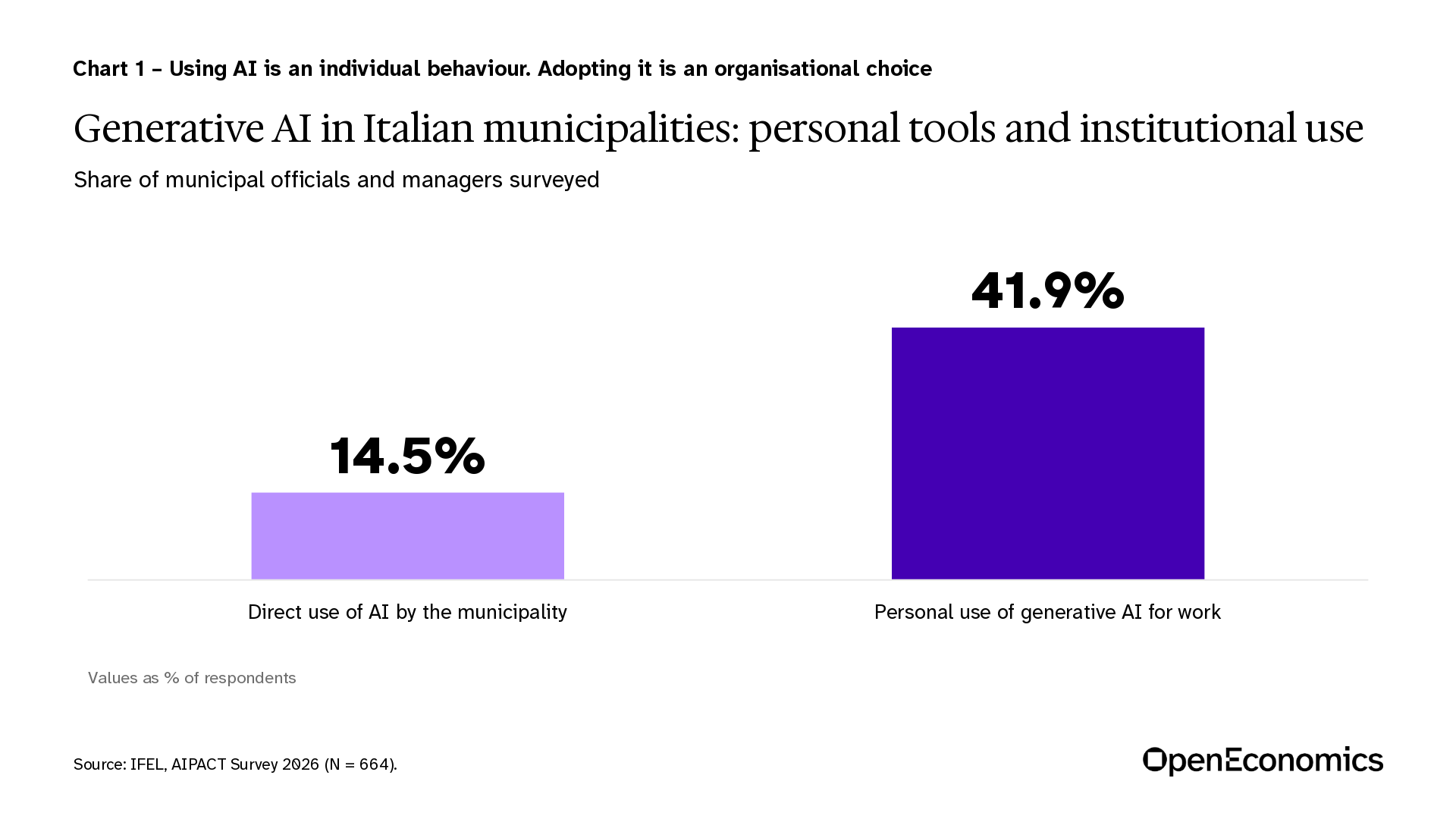
More than four in ten Italian municipal employees already use generative artificial intelligence in their work, and they often do so outside internal rules and contracted tools. This is the finding of a study by the Institute for Local Finance and Economy (IFEL) conducted among 664 municipal officials and managers between November 2025 and March 2026 within AI-PACT, the European Digital Innovation Hub (EDIH) for public administration coordinated by SDA Bocconi School of Management. The same survey shows that only 14.5% of respondents report a direct use of AI by their own municipality, and that 55.7% have not taken part in any AI training in the last twelve months. The point is no longer whether artificial intelligence should enter public offices: in many of them, it already has. The useful question for those who govern is how to make it work, with which objectives and with which safeguards on data, human oversight and accountability.
What is meant by "shadow AI", and why does it concern public administrations?
The term "shadow AI" refers to the use of artificial intelligence by an organisation's staff outside an authorised perimeter. On the one hand, the phenomenon signals a real demand for support with tasks such as drafting texts, summarising documents and searching for information: for planners, it shows where staff perceive the heaviest workloads. This use, however, exposes the organisation to risks that nobody has assessed, such as entering public employees' personal data into external services, unverified outputs and a lack of traceability. There are also compliance risks: the General Data Protection Regulation (GDPR) applies to any personal data entered into an external service. In addition, the EU AI Act requires those who use AI systems to take AI literacy measures for their staff, and Italian law requires technical, organisational and training measures.
What lies behind informal use by public employees?
A problem of operational capacity. To launch a tender, an Italian municipality applies EU directives and the national Public Contracts Code, complies with minimum environmental criteria (CAM) and, where required, with the "do no significant harm" principle (DNSH), and justifies a base price consistent with the market. New tools can help, especially with limited staff and tight deadlines, provided that their use does not become a further layer of complexity.
What does the gap between individual use and institutional use of AI indicate?
The gap found by the IFEL study between the 41.9% who use generative AI for work and the 14.5% who report a direct use by their own municipality measures a space where decisions are taken by default, by the individual official, and not by the organisation. For an administration, the first step is to know that space and to understand which tasks are already carried out with AI, with which tools and on which data.
What forms can a governed adoption of AI take? What do European experiences show?
The European picture helps to show the forms that a governed adoption of artificial intelligence can take. The European Public Sector Award (EPSA), held every two years by the European Institute of Public Administration (EIPA), received 134 applications from 30 countries in its 2025-26 edition. The award-winning applications, meaning those that reached the podium, number 9; including the good practice certificates, the total rises to 33, and to 48 when the 15 special recognitions reserved for projects from previous editions are added. The awards ceremony took place in Maastricht on 24 September 2026. We examined a first group of nine projects with an explicit AI component across the 2023-24 and 2025-26 editions. A first analysis shows that very different choices coexist under the same label, and that they can be grouped into three ways of introducing AI.
What is the first of these three ways?
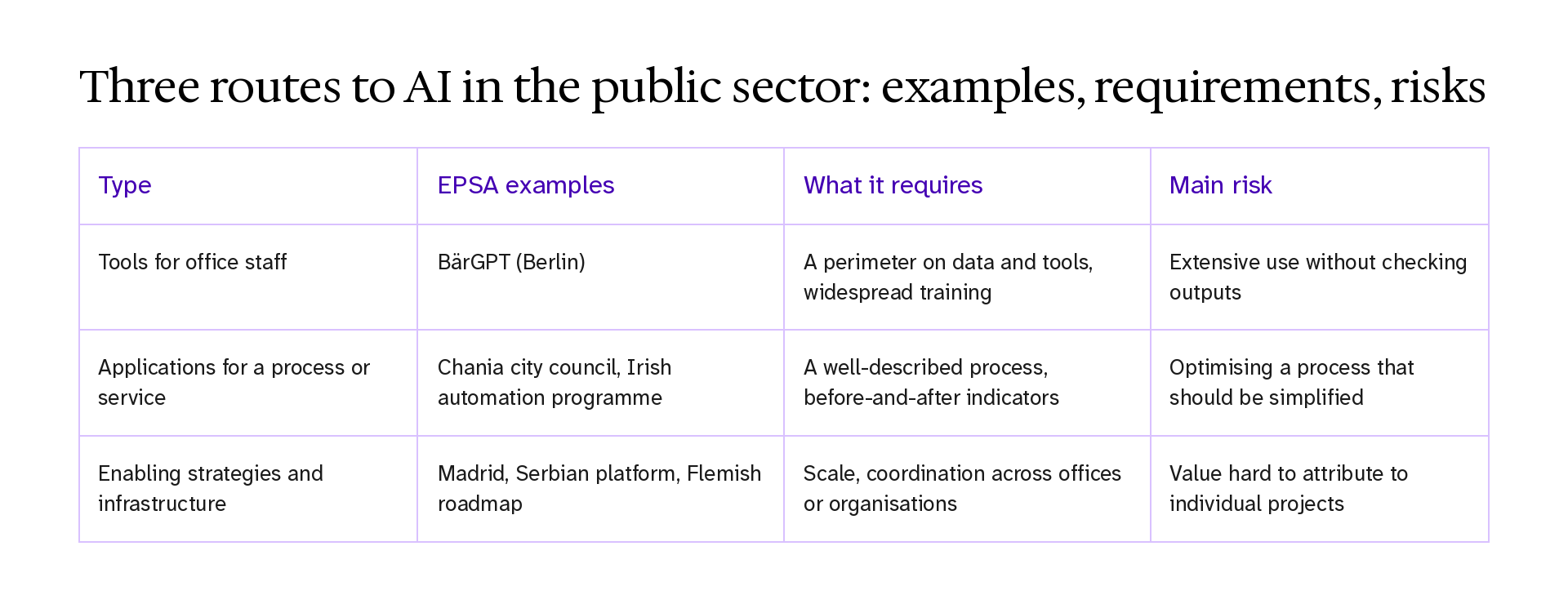
Tools for office staff. This is the form closest to what municipal staff already use informally. BärGPT, the AI assistant of the administration of the Land of Berlin, which ranked second in the category for services at territorial level, is used by around 19,000 employees about ten months after its launch. The difference from spontaneous use lies not in the technology, but in the perimeter: which data can be used, with which tools and under whose responsibility.
And the other two?
The second concerns applications for a single process or service. Here AI serves a defined objective. The Municipality of Chania, in Greece, uses it to make the proceedings of the city council accessible and searchable. Among the winners of the 2023-24 edition is an Irish process automation programme that incorporates AI components. This is the easiest form to assess, before and after: results are measured on the process, in terms of time, volumes and quality.
The third group, enabling strategies and infrastructure, creates the strategic and infrastructural conditions for delivering services. It includes Madrid's digital government strategy, Serbia's national AI platform, awarded in 2023-24, and the adoption roadmap of the Flemish agency for foreign trade. The value is indirect, because it comes with subsequent projects. The scale is that of a large organisation or a national level: for a small municipality, the realistic equivalent more often lies in infrastructure shared at inter-municipal level.
What role do internal rules play when the use of these tools is extended?
Rules first, then scale. An internal act defining scope, permitted data and responsibilities accompanies the extension of tools and makes it possible. For a local authority, this can be an internal regulation or a section of the Integrated Activity and Organisation Plan (PIAO), the planning document of Italian public administrations, devoted to work organisation and training. Training itself, with more than half of staff still without dedicated courses, is the variable most directly in the administration's hands.
How can an AI decision be made defensible for those who govern?
Introducing artificial intelligence in public administration is an organisational change and a change of mindset, not the purchase of a technology. The "how" becomes a sequence in which the tool comes last. This applies to a large organisation as much as to a small municipality: the scale changes, the logic does not. The sequence involves planning, organisation and training activities.
It starts with needs and a measurable objective: begin with the tasks where most time is lost, using spontaneous use as a map, and set the expected result (processing times, case volumes). Then come the people involved: recognise which roles change and involve managers, officials and staff representatives from the outset. Next, rules and human oversight: define in an internal act the permitted data and tools, who checks the output and who is accountable for it. Then training, not only on the tools but on how to frame a problem and verify the result: this is what makes human oversight effective. Finally, technology, alternatives and indicators: only now choose the tool, compared with at least one alternative without AI or shared with other organisations, and decide what to measure.
In the end, what changes for public offices and for those who govern?
There is also a less visible effect: if AI absorbs part of the repetitive work, the ability to frame a problem, read data and justify a choice matters more in public offices. A decision built in this way has something to rest on before an audit body, a city council or citizens. More than four in ten municipal employees have already answered the question "whether". The answer to "how" remains with those who govern the organisation, and it is the one that can be explained and defended.