

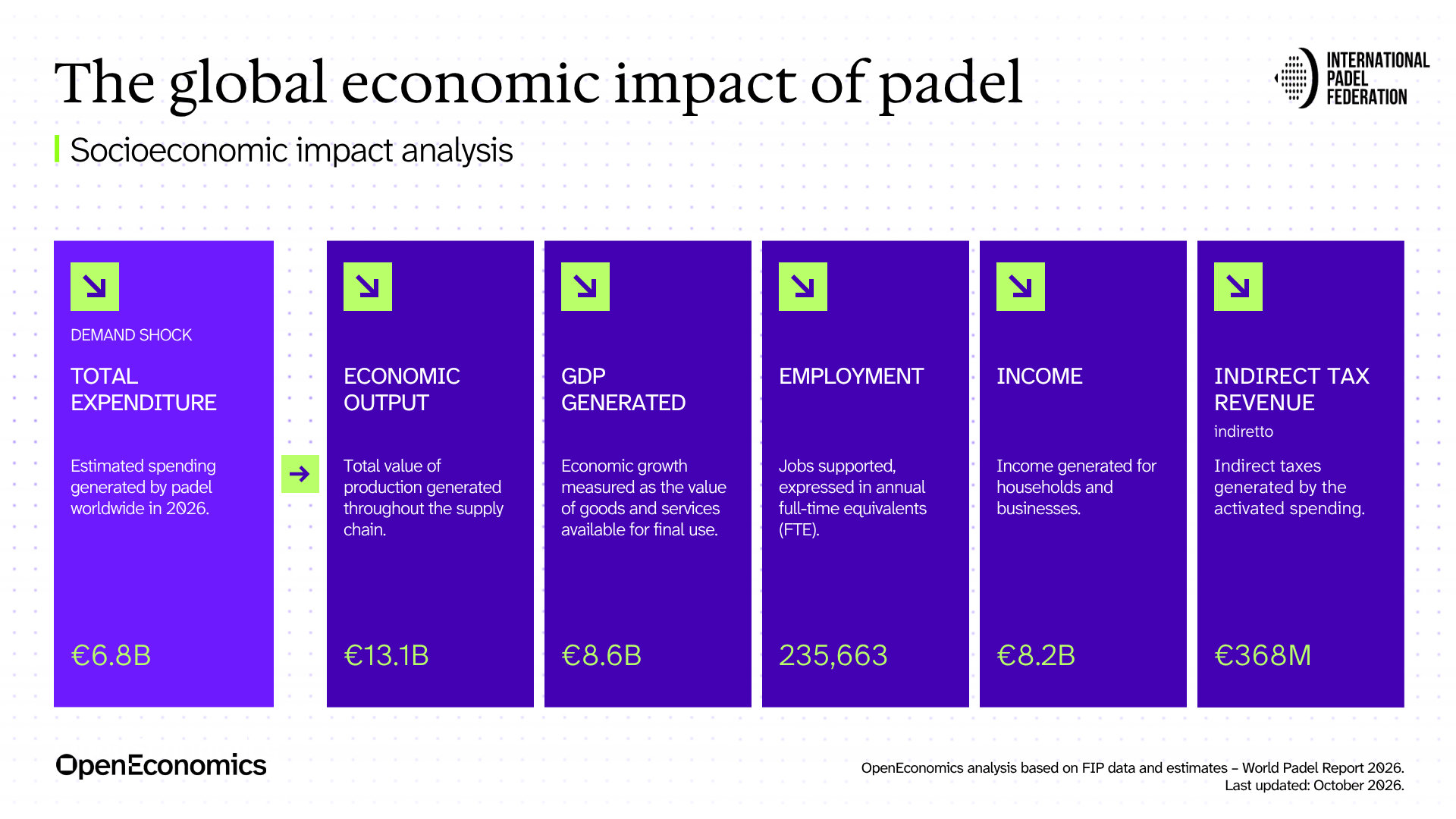
Every euro spent on padel generates 1.26 euros of GDP. And almost all of the value is created on the courts, not at tournaments. These are the main findings of the World Padel Impact chapter, the analysis of padel's economic impact worldwide that OpenEconomics developed for the World Padel Report 2026 of the International Padel Federation (FIP). In 2026 the sport activates 6.8 billion euros of spending, which generate 8.6 billion euros of GDP, 235,663 jobs (FTE) and 368 million euros of tax revenue.
Study objectives
On 12 October in Madrid, at the 36th FIP General Assembly, FIP President Luigi Carraro presented the third edition of the World Padel Report 2026. The report maps the sport's global development on the basis of the FIP National Federation Survey 2026.
World Padel Impact, the section of the study devoted to impacts, has two aims. The first is to document the sport's growth: 115 affiliated federations, 15 of which joined this year. The second is to show what that growth produces in terms of GDP, employment, income and tax revenue, across 76 countries plus a "rest of the world" aggregate.
Main findings: the economic impact of padel in 2026
In short, the economic impact of padel is worth 8.6 billion euros of GDP. The analysis does not measure how popular padel is. It measures what the spending the sport activates produces: every euro spent generates 1.26 euros of GDP. The path from spending to the economy can be read in six numbers:
- Spending activated: 6.8 billion euros, the demand shock generated by padel in 2026.
- Output: 13.1 billion euros, the total value produced along the supply chain, including purchases between firms (1.91 euros for every euro spent).
- GDP: 8.6 billion euros, the new wealth created, net of purchases between firms so that they are not counted twice.
- Employment: 235,663 annual FTE (full-time equivalent jobs for one year).
- Income: 8.2 billion euros, split almost evenly between labour income (4.2 billion) and capital income (4.0 billion).
- Tax revenue: 368 million euros of indirect taxes, 5.4 cents for every euro spent. Direct taxes on income are not counted.
Where padel spending comes from
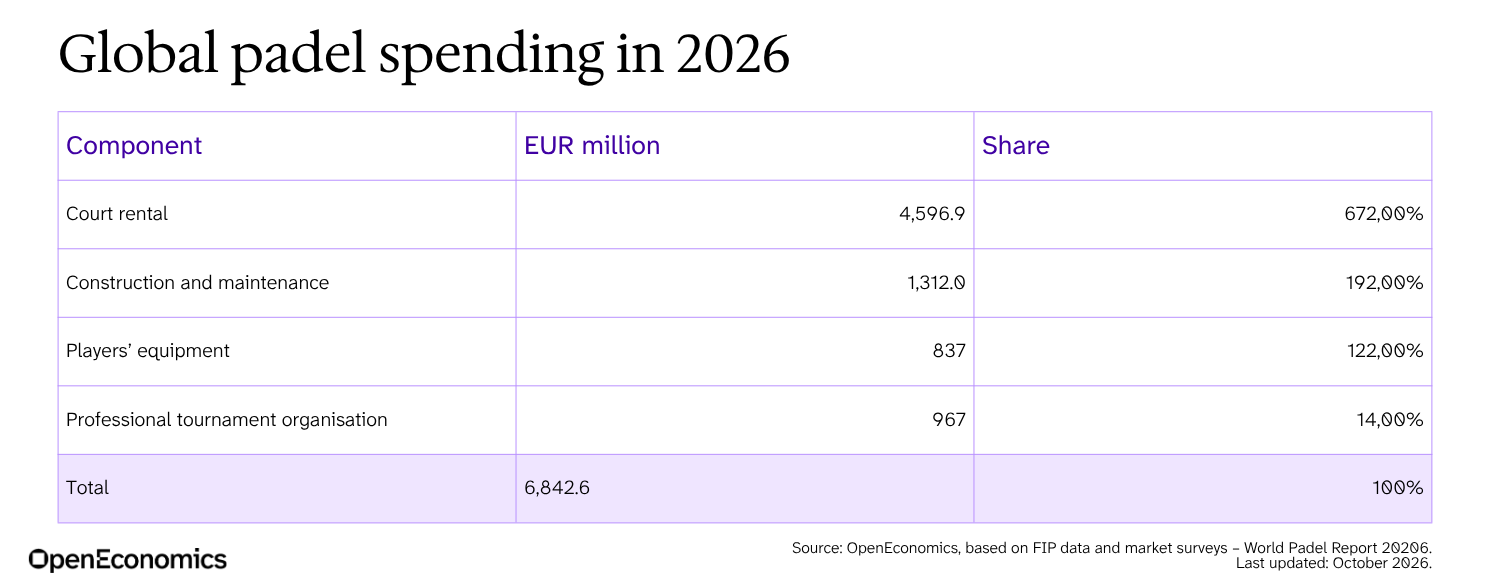
Spending in the padel system in 2026 is worth 6,843 million euros. Court rental accounts for 67.2% of it. Next come construction and maintenance of facilities (19.2%, of which 746.2 million goes to manufacturers and 565.8 million to local construction) and players' equipment (12.2%). Professional tournaments, the sport's media showcase, account for 1.4%. What moves the economy is the everyday play of enthusiasts.
How the value spreads
Not all of the value stays where the game is played. Thestudy breaks GDP down into three components, each following a different logic:
Direct impact (65.7%): the value generated by thosewho receive the spending: clubs, builders, manufacturers, shops and tournamentorganisers. It weighs this much because court rental is a service that isproduced and consumed on the spot.
Indirect impact (13.7%): thevalue that travels up the supply chains, from steel to logistics. Here Chinastands out as a producer of structures and equipment, with 105.8 million eurosof indirect GDP.risale le catene difornitura, dall'acciaio alla logistica. Qui emerge il ruolo della Cina comeproduttrice di strutture e attrezzature: 105,8 milioni di euro di PILindiretto.
Induced impact (20.6%): the value that comes from thewages spent by people working in the supply chain, on things like a smartphone,a pair of shoes or a car. These purchases follow the geography of globalmanufacturing, not that of the courts: 29.7% of induced impact goes to theUnited States and 14.1% to China.
Indirect and induced impacts cross national borders. 66.4%of the output activated stays in the country where the spending takes place,and the rest travels abroad. As a result, the United States and China togetherreceive 13.5% of the GDP generated by padel, while accounting for 4.9% of thespending. It is not padel that moves there: it is global consumption.
The economic impact of padel in Spain and Italy
In the two main European markets, the ratio of GDP to spending is closer to 1 than the world average. In Spain, 1,109 million euros of spending produce 1,042 million of GDP (0.94 euros for every euro spent). In Italy, 810 million produce 826 million (1.02). The reason is court rental. In Spain it is worth 605 million euros and stays entirely within the country. Where rental prevails, value is generated locally, while the share tied to supplies and consumption is distributed across the rest of the world.
Per capita, the ranking changes. Sweden leads with 27.95 euros of GDP per inhabitant, ahead of Spain (22.00). Italy is eighth with 13.89 euros, and the top fourteen territories by intensity are all European.
Employment follows a different logic: jobs concentrate where labour productivity is lowest. China, Indonesia, India and Egypt host 39.1% of estimated FTE, against 9.5% of GDP.
Methodology
OpenEconomics reconstructed the impact of spending along thesupply chains that receive it, using a social accounting matrix (SAM). The SAMlinks sectors and countries and is built on the input-output tables of the OECD(Organisation for Economic Co-operation and Development): 76 countries plus therest of the world, and 45 sectors of activity. Spending was reconstructed bymultiplying four quantities recorded by the federations (courts in use, newcourts, players, circuit events) by unit market costs.
The scope includes only what can be measured with robustdata. Membership fees, lessons, media rights, sponsorships, sports tourism andspectator spending at events are left out, and occasional players are notcounted. For this reason the estimates should be read as a minimum value.
The data on courts and players expected in 2026 arefederation forecasts, not final figures. FTE reflect the productivity ofindividual countries and cannot be compared between territories with differentwages. Finally, the study covers padel worldwide, a different scope from theFITP Report on tennis and padel in Italy.
Key takeaway
> What the study measures: the spending activated by padel in 2026 and its effect on the economy, not the sport's popularity.
> What it is worth: 6.8 billion euros of spending generate 8.6 billion euros of GDP (1.26 euros for every euro spent), 235,663 annual FTE and 368 million euros of indirect taxes.
> Where the value arises: on the courts. Rental accounts for 67.2% of spending, professional tournaments for 1.4%.
> How it spreads: 65.7% of GDP is direct impact, 13.7% indirect and 20.6% induced. The last two cross borders: the United States and China receive 13.5% of GDP with 4.9% of the spending.
> How to read it: these are prudent estimates, based on federation forecasts for 2026. FTE should not be compared across countries.
.jpg)

.png)








.png)