

Only one in five companies is aware of the incentives available for its sector and territory. This is what Unioncamere found in 2025, and the figure is less surprising than it seems: the distance between a valid project and a funded application is bridged by specific expertise that is often simply not there.
For the circular economy, 2026 is a busy year. Across European, national and regional instruments, total funding comfortably exceeds one billion euros. Yet most companies do not apply. And among those that do, a significant share fails to obtain financing - not because of the quality of the project, but because of how the application was put together.
Why public funds stay on paper
The block consists of three barriers that compound one another.
The first is knowledge: companies are unfamiliar with the frameworks within which public grants operate and struggle to align their industrial objectives with those of the funding programmes. Without a map of available instruments, applications never get started.
The second is technical: even with a solid project, the internal resources needed to manage complex application processes are often lacking. A valid funding opportunity, without the skills to pursue it, stays on paper.
The third - perhaps the most underestimated - is the fear of reporting. The worry of losing funds, incurring liability, or failing to survive an audit blocks more projects than their actual merit would justify.
The real challenge is the ability to turn funding into certain value.
The 2026 landscape: European, national and regional instruments
Available instruments operate at three levels, each with very different logics.
European instruments are primarily research and innovation programmes: LIFE, Horizon Europe, CBE JU. Aid intensity up to 100% for certain actions, grants per project up to €25–30 million. The price to pay is complexity: international consortia, high-innovation topics, competitive procedures with windows concentrated almost entirely in autumn 2026. These are not instruments for those who start an application without prior preparation.
National instruments hold the largest funding pools and are the most accessible for individual companies. Invitalia Economia Circolare operates on an open-window basis — those who are ready need to move now, until funds run out. Contratti di Sviluppo STEP (nearly €500 million) and Investimenti Sostenibili 4.0 (€448 million) target southern regions with aid intensity up to 85%, but require a solid industrial project and DNSH compliance built in from the outset, not patched together at the last minute.
Regional instruments have smaller allocations but very high intensity - up to 100% in Liguria - and a strongly territorial focus. The Ligurian call closes on 31 July 2026 and previous editions exhausted resources ahead of schedule. Ri.Circo.Lo. in Lombardy and the EC Sardegna call complete the picture for SMEs based in their respective regions.
Three parameters to immediately filter out incompatible instruments
Before even looking at amounts, it is worth checking three dimensions:
• TRL: every call works within a specific range of technological readiness. A project still at the experimental stage does not belong in the same call as a fully defined industrial investment.
• Eligible costs: some instruments cover primarily staff and consultancy (R&D), others machinery and construction works (industrial). If the main cost items fall outside the eligible perimeter, the actual grant shrinks to the point of irrelevance.
• Alignment with call objectives: eligibility alone is not enough. A project misaligned with the declared objectives - industrial symbiosis, end-of-waste, waste reduction - scores poorly even when it is technically sound.
The three most costly mistakes
At the tables of those who manage complex applications, mistakes recur with almost mechanical regularity.
The first is the absence of planning: the decision to apply is made before checking whether the project actually holds up. The proposal is born from enthusiasm, not from data. In the worst cases, expenditure is incurred that - started before the application or outside the eligible perimeter - cannot subsequently be reported.
The second is an unrealistic activity plan: overly optimistic timelines, milestones the project will not be able to meet. Delays push back disbursements. Serious ones trigger partial revocation of the grant for failure to reach interim targets.
The third is a poorly structured partnership, especially for European calls: redundant partners, unclear roles, expertise inconsistent with the topic. An unbalanced consortium lowers the score at evaluation and complicates governance during implementation.
Translated for decision-makers: the assessment must be done before writing the proposal, not after deciding to apply.
From application to payment: how a serious process is structured
A fundable project is not simply a good project. It is a good project built to withstand scrutiny, implementation and reporting.
The process unfolds in four distinct phases. The first is matching: continuous scouting and monitoring of opportunities, cross-referencing project characteristics with the requirements, eligible costs and windows of each measure. Many instruments operate on an open-window basis and open or close depending on available resources - catching them at the right moment is the difference between participating and arriving too late.
The second is assessment: technical and financial feasibility analysis against the chosen call. It is the filter that prevents launching a weak application. With a data-driven approach, the result is an informed decision - proceed or not - built on numbers, not expectations.
The third is application: document collection, design and drafting of the proposal. Technical dossier, financial plan, formal attachments built to withstand scrutiny. This is where a valid project becomes an admissible application.
The fourth - and the one most often overlooked at the planning stage - is cash in: technical and financial reporting through to the final disbursement of the grant.

Reporting is not the last step: it is the first
The most underestimated cost is not external consultancy fees. It is the hours of internal staff absorbed by document management: gathering evidence, manual revisions, uploading to portals. It needs to be budgeted from the start, because the risk of revocation is real - fragmentation of rules, regulatory volatility and incomplete traceability are among the most frequent causes of losing a grant.
Those who expect to tackle reporting after implementation, without having set it up from day one, will find themselves trying to reconstruct what can no longer be recovered.
Why the circular economy is worth a serious investment at this stage
The resources available in 2026 for the circular transition are not ordinary. The convergence of next-generation European instruments - from the Clean Industrial Deal to the LIFE and CBE JU programmes - and a national allocation of over €1.1 billion creates a window that will not reopen in the same form. Many open-window calls are running until funds run out. Some European deadlines are concentrated between September and October 2026 with no possibility of repetition within the year.
For a company that has already identified a circular transition project - or that is evaluating an investment in industrial symbiosis, smart packaging, recycling or end-of-waste - the question is not whether funding exists. The question is whether the organisation is structured to access it before it runs out.
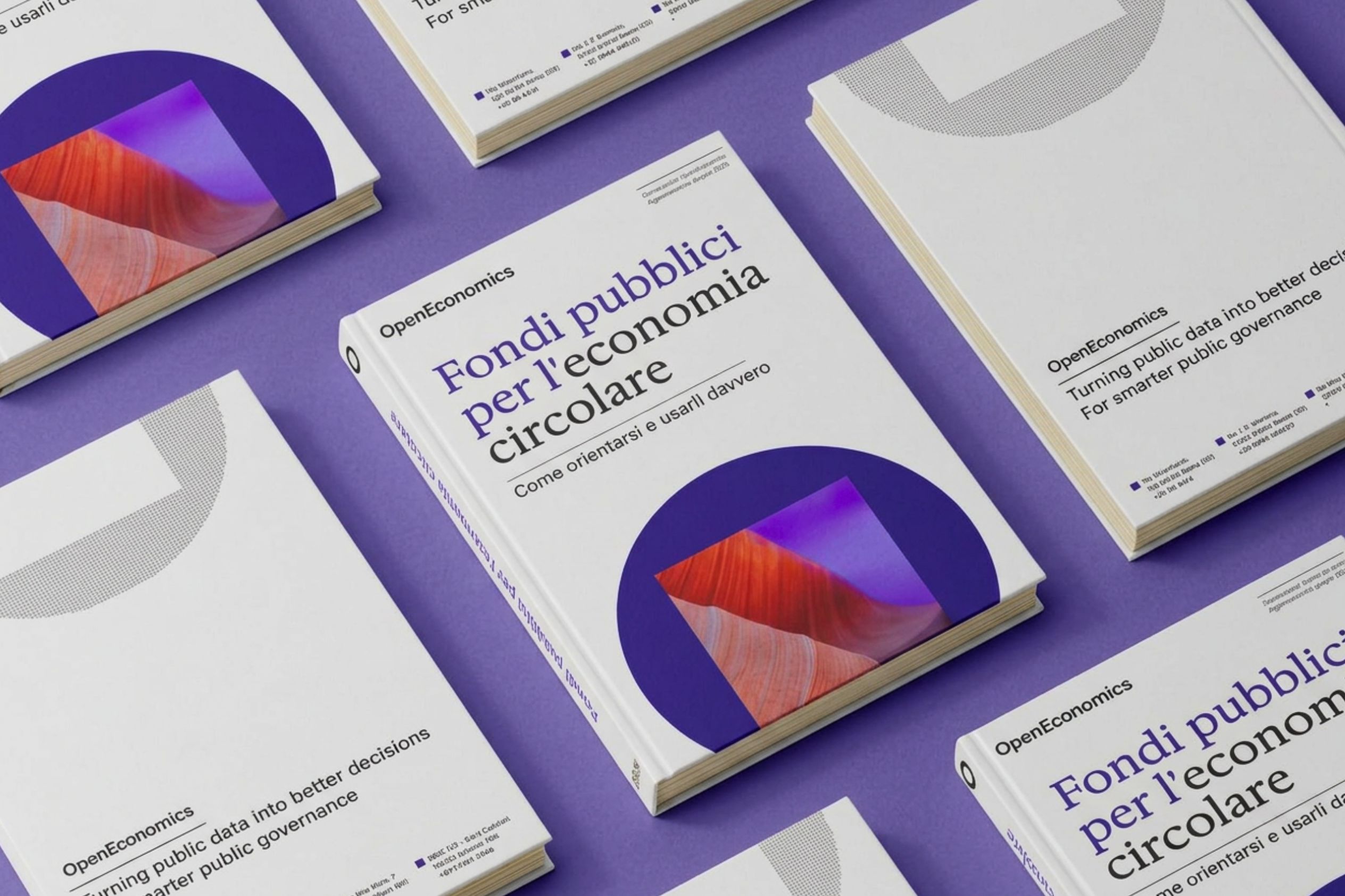
Download the Guide to Circular Economy Funding by clicking here.




.png)







.png)