


Expectations around institutional efficiency, service quality and policy transparency are increasingly high. In an age of multiple transitions – digital, environmental, demographic – the public sector cannot simply manage the status quo: it must take the lead, using digital governance and platforms to better direct resources, support decisions with solid data and assess policy impacts systematically. This change is already possible: today, solutions exist that allow public bodies to move from fragmented management to smart governance, with a stronger ability to choose, measure and communicate clearly.
The public sector as an engine of development
The public administration is one of the main drivers of economic and social development, because the quality of governance, service efficiency and the ability to implement effective policies are key to productivity, investment and social cohesion.
OECD’s Government at a Glance 2025 highlights how stronger administrative capacity, digitalisation and better regulation are crucial to turning public resources (including NRRPs and EU funds) into sustainable, inclusive growth, making public sector transformation a macroeconomic lever for competitiveness, trust and social stability rather than a purely technological project.
Citizenship, digital governance and public sector quality
Citizenship is expanding and becoming stronger thanks to digital governance: digital identity, online services, participatory platforms and open data increasingly act as infrastructures that enable rights, access to services and participation in public decision-making.
OECD analyses show that well-designed open government data policies improve transparency, innovation and problem‑solving capacity, and Italy is part of this evolution, with public bodies moving from a pure service‑provider role to that of architects of digital ecosystems that reshape relations with citizens and businesses.
The two sides of smart governance
When speaking of digital public administration, two major “actors” emerge: central government and local government, with partly overlapping and partly specific challenges.
Central government must steer system‑wide policies, plan strategic investments, coordinate large programmes such as the NRRP and ensure interoperable, coherent rules and standards, while local authorities focus on choosing the most effective investments for their territories, accessing and managing funds and improving front‑office services and accountability to citizens.
Criticalities seen from the field
The way digital transformation is approached is crucial to making the daily work of central and local public administrations easier and more effective.
OpenEconomics experts dedicated to the public sector support institutions in developing innovative, proactive and efficient solutions that accompany institutional transformation, sustainability programmes and concrete improvements in community well being.
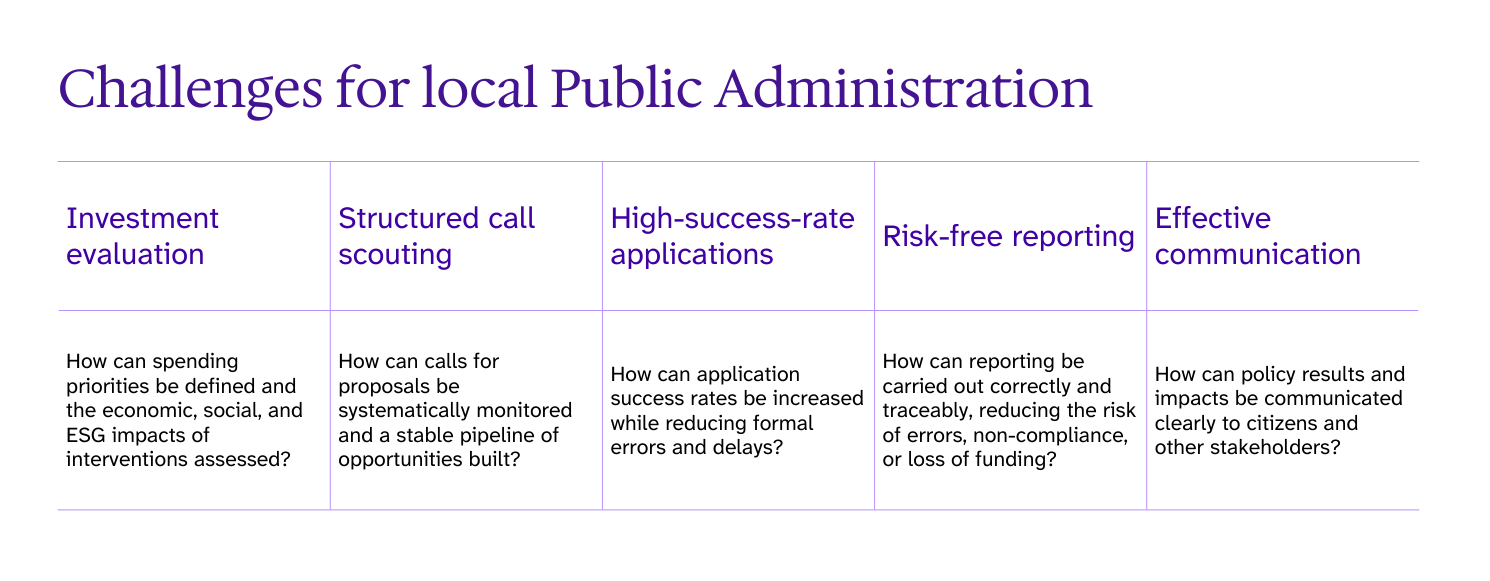
• Choosing the “horses” to back (investment evaluation): support in defining spending priorities through impact assessment models (GDP, employment, income, tax revenue, ESG indicators) and cost benefit analysis, also using platforms such as Civiqa to compare policy scenarios and project alternatives with objective, comparable data.
• Structured funding opportunity scouting: intelligent search engines and thematic filters to identify European, national and regional calls aligned with development goals, combined with alert, profiling and strategic advisory services to build a steady pipeline of opportunities.
• Flawless applications: digital workflows, pre configured templates and compliance checklists help build solid applications aligned with programme criteria, supported by training and coaching to reduce formal errors, meet deadlines and increase success rates.
• “By the book” reporting: project management platforms and reporting modules track costs, milestones, indicators and supporting documents, with automated checks, audit trails and ready to use reports for national and European verifications.
• Effective communication and policy value creation: interactive dashboards, infographics and concise briefs turn complex data into clear narratives for citizens, media and stakeholders, supported by evidence based storytelling that explains results, impacts and the value generated by public policies.
Central government’s key work areas
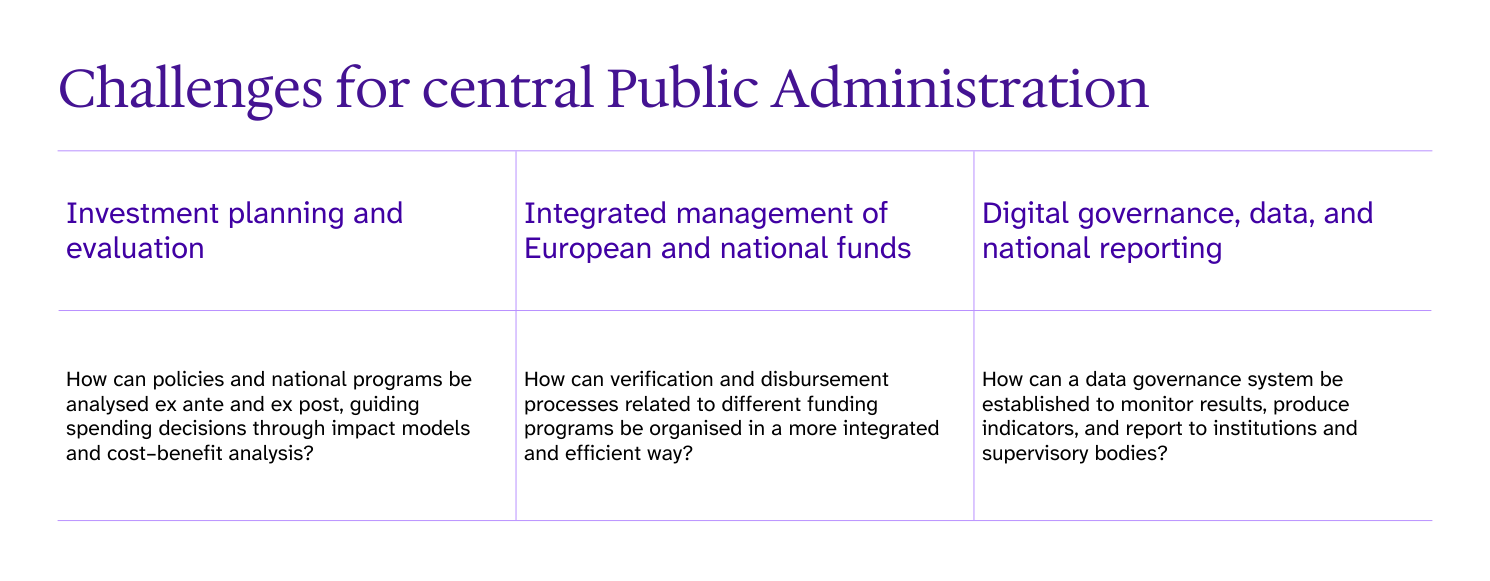
1. Planning and evaluating public investments: ex ante and ex post assessment of national policies and programmes, using impact models and cost benefit analysis to guide spending decisions.
2. Integrated management of European and national funds: structured scouting and selection of funding opportunities, coordination of applications, management and reporting for major programmes such as the NRRP and structural funds.
3. Digital governance, data and national reporting: implementation of digital governance platforms and data governance systems for ministries and agencies, monitoring of results and production of indicators and reports for Parliament, the European Commission and oversight bodies.
An ecosystem for the digital transformation of the public sector
In this context, the response – from the OpenEconomics perspective – has two components.
On one side, an ecosystem of tools built around three pillars (spending decisions, impact analysis and public funding for the integrated management of calls and public funds throughout the project life cycle); on the other, a tight alignment between technology and regulation, so that digital tools become real value adding levers rather than an additional administrative burden.
OpenEconomics has been working on these topics for years and, with Civiqa, is building a digital governance platform and a set of capabilities that help public administrations fully play their role as engines of economic and social development and guarantors of informed participation in public decision making.
The editorial plan aims to narrate this journey, consistently focusing on the real problems faced by public bodies and on the concrete solutions that can turn the digital transformation of the public sector into an opportunity instead of an extra burden.




.png)








.png)