


Municipalities, provinces, metropolitan cities and regions represent the most direct point of contact between the State and citizens: this is where civil registry services, local taxes, local welfare, mobility, schools and the environment are managed. Digital transformation in local public administration is concrete and visible: an online service desk that works, TARI payment via app, a PNRR project that reshapes the relationship between citizens and administration. However, local public administration operates with limited resources and lean structures, in a fragmented and diversified context. For this reason, digital governance solutions designed to be scalable, easy to adopt and adaptable to very different territories transform administrative complexity into local governing capacity.
Digital innovation and territorial governance
Local authorities are where digitalisation produces immediate effects on people’s lives: from booking a certificate online to monitoring a construction site financed with European funds, from communicating a tax deadline to a public consultation on an urban plan.
Yet the data shows a still significant gap. According to the Report "Mappa dei Comuni digitali" 2025, published by the Department for Digital Transformation and ANCI, 80% of municipalities already provide public services digitally, but many have digitalised only the front office, without integrating internal processes. This means that the citizen can start a procedure online, but the back office continues to work manually, with inefficiencies and risks of error.
The good news is that PNRR investments are accelerating transformation: over 90% of Italian municipalities have launched digitalisation projects in the last three years, with particularly positive results in the adoption of standardised platforms such as SPID/CIE, pagoPA and app IO. The challenge now is to consolidate this digital infrastructure and make it an ordinary tool of local governance.
Where local public administration can make the difference
Local public administration operates in a context characterised by:
• technological fragmentation and a lack of widespread digital skills;
• growing pressure to deliver efficient services with limited human and financial resources;
• the need to identify and manage complex calls for proposals (PNRR, European, regional funds) with staff often lacking dedicated structures.
In the period 2007 - 2023 Italian municipal staff decreased from 479.233 to 341.659 employees, a loss of 28,7% corresponding to 137.574 units. This means that today municipalities manage public services and investments (doubled in value) with almost one third fewer staff. It is therefore not surprising that the effectiveness of local action is increasingly linked to the ability to govern data, processes and skills in an integrated way, without dispersing energy in repetitive compliance tasks.
Overcoming system fragmentation to govern integrated services
One of the most critical issues for local public administration concerns the fragmentation of information systems. Many municipalities manage services on different applications that do not communicate with each other: one system for civil registry, one for taxes, one for urban planning, one for funded projects. The result is a labyrinth.
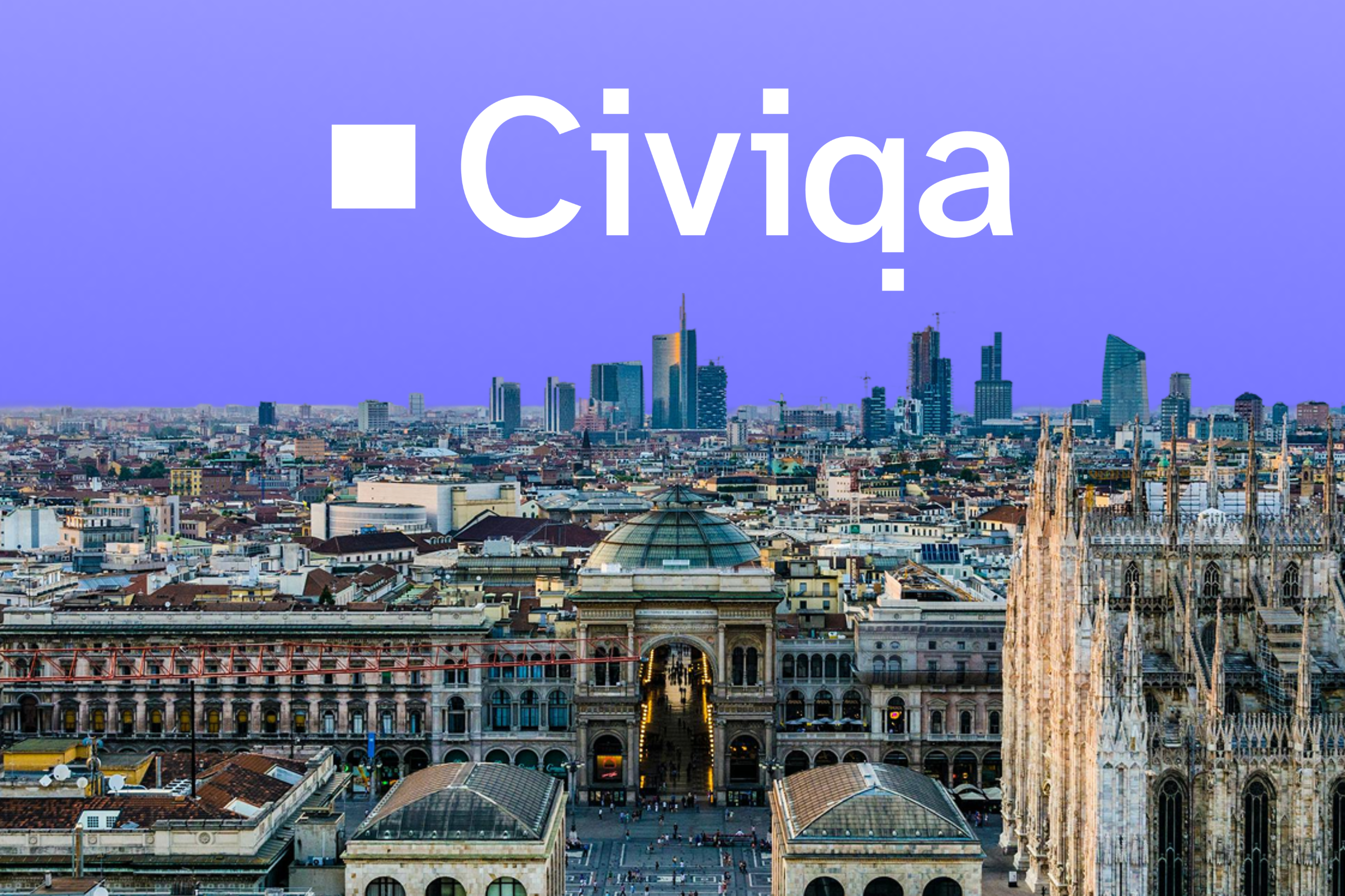
According to PNRR monitoring, 90% of municipalities have joined the National Digital Data Platform (PDND), the infrastructure that enables interoperability between public databases according to the "once only" principle. But formal adherence is not enough: systems must be concretely integrated and staff must be trained. This is the approach we are adopting with Civiqa, a platform that allows local authorities to carry out, in a single environment, organisational health diagnostics, comparative analysis of different projects and investments and fund reporting.
An example: from the call for proposals to reporting
A typical example of fragmented management concerns calls for proposals. To finance projects on schools, mobility, urban regeneration or energy transition, municipalities must navigate a complex ecosystem of calls often layered and with stringent requirements. For many authorities, especially small and medium sized ones, the most critical phase is not only the application, but the entire management of the project life cycle: from reporting to controls, up to final disbursement.
This is the paradigmatic case of a small municipality that, for example, wins a call for the energy refurbishment of a public building. During reporting, it must retrieve documents from different suppliers, verify compliance of expenses, upload documents to regional and national platforms, comply with multiple deadlines. Without adequate digital tools, the risk of formal errors and delays is very high, with consequences on disbursements.
How can technology help? Tools such as Sonar guide organisations throughout the entire reporting process step by step, through guided workflows, pre filled templates, compliance checklists and automatic controls, which help manage all the steps required by the rules of different calls, coordinate multiple offices on the same procedure and track expenses, supporting documents, milestones and indicators for each project. The generated reporting is designed to be easily reused in reports to ministries, regions and managing authorities, reducing workload and risks of remarks.
Measuring the local impact of policies to communicate value
In addition, local public administration is increasingly required to answer a key question: what effects do public investments produce on the territory?
It is not only about spending resources, but about demonstrating the impact of local policies on the economy, employment, income and sustainability. This applies in particular to programmes financed with European and national funds, where ex ante and ex post evaluation has become a structural requirement.
A concrete case is that of the municipality of Vibo Valentia which, to estimate the socio economic impact of municipal spending choices, used Civiqa’s analytical tools. This made it possible to credibly measure value creation, distinguishing direct, indirect and induced impacts, in support of evidence based decisions and dialogue among different stakeholders.
This approach enables more integrated, transparent and value driven governance of public spending for the territory, allowing comparison between alternative spending scenarios and more effective communication with citizens and local stakeholders. The presentation of results through interactive charts allows authorities to publish on institutional websites clear information on ongoing projects, funds used, results achieved and estimated impacts, contributing to strengthening trust and participation.
Digital skills as a lever for territorial acceleration
Digital transformation cannot disregard people. Here too, data helps to read the context. Only 41,3% of Italians interact with public authorities through the Internet, compared to 54,3% of the EU average. Less than half of Italians aged between 16 and 74 possess basic digital skills according to European standards (45,7%), a value below the EU average and far from the objectives of the Digital Decade 2030.
This data has a direct reflection on local public administration: the adoption of advanced tools for governance, fund management and policy evaluation requires skills that must be built and disseminated starting from within administrations.
For example, specialised but easily usable software, accompanied by structured training paths, make it possible to manage multiple funding sources without increasing the level of stress within the administrative structure, facilitate the application of procedures in a more efficient way, and raise the level of skills well beyond the restricted group of specialists, strengthening the digital skills of managers and officials at every level.
Transformation that can be seen from the territories
The numbers show that the challenges are real, but also indicate a huge margin for improvement. Many cases of excellence already demonstrate that local digital transformation is possible, measurable and produces concrete results, especially when accompanied by a training path.
Among the most well known examples, Vibo Valentia (with the measurement of the socio economic footprint of municipal spending), Salerno (35 services completely online), Milan (with its Digital Twin and smart mobility projects), Bologna (advanced Wi Fi network and open data), Brescia (digital twin for smart city transformation) and Rome Capital (over 650 thousand messages for TARI payments via app IO with 68% collection within the deadline).
It is on this ground that local public administration can strengthen its role as a protagonist of widespread digital transformation, making services closer to citizens and territories more competitive and resilient.



.png)







.png)